

A Texas fence replacement quote should include five things in writing: the footage measured on your property, the material and picket grade, what can change the price (including old-fence tear-out and haul-off), the warranty and what it covers, and a start date. The total tells you almost nothing on its own.
The line homeowners most often find missing is the picket grade. You can check any Texas bid against these five lines in about ten minutes.
Why Does the Detail on a Fence Quote Matter More Than the Total?
Because the detail decides what the total buys. Everything above the total is where the money actually gets decided. 70% of property owners went over budget on their most recent renovation, and 10% came away regretting the contractor they chose (Clever Real Estate, 2026). A bid that names footage, grade, removal, warranty, and a start date leaves almost no room for either outcome. A bid that names a price and a wood species leaves room for both.
The trap is that a vague quote and a precise quote look the same in your inbox. Both are one page. Both end in a dollar figure. Only one of them tells you what is going in the ground.
| The line | What it should name | What is missing without it |
|---|---|---|
| Scope and footage | Linear feet measured on site, plus corners, ends, and gate openings | Whether anyone has seen your yard |
| Picket grade | The grade written out, #1, #2, or #3 | Which boards you are buying |
| Price triggers | Old-fence removal, soil, gates, permits | Who pays when the job changes |
| Warranty | Craftsmanship, material, and the term in months or years | What happens if a post leans |
| Schedule | Quote date, start date, and expected finish | When you get your yard back |
How Should a Fence Contractor Measure Your Yard?
With a wheel or a tape, standing on the property. Real footage comes from a wheel or a tape on your property, not from a satellite photo. The Federal Trade Commission tells homeowners to insist on written estimates that list the work, the materials, the completion date, and the price (Federal Trade Commission, 2024). Footage is the first of those, and it is the one every other number multiplies against. Get it wrong by 15 feet and the whole quote is wrong.
We measure every job before we price it. A rough number goes out over the phone from the address, then a salesperson meets you at the house, walks the line, counts the corners, and confirms the gate openings. That is the expensive way to do it. It is also the reason our crews show up with the right amount of material on the truck.
Ask any bidder one question: who measured this, and when were they here? A quote written from a map is a guess wearing a suit.
Should a Fence Quote Name the Picket Grade?
Yes, because the word cedar is not a specification until a grade sits next to it. Two Texas quotes can both say “6 ft cedar privacy fence,” be $1,200 apart, and both be honest, because one was written against #1 boards and the other against #3. Nobody has to lie for that to happen. The cheaper bidder simply never wrote the grade down, and you never asked.
Here are the terms that should appear in plain language on the page.
| Term | What it means on your quote |
|---|---|
| Linear foot | The unit fencing is priced in, measured along the fence line, not by panel |
| Picket grade | The board grade, written #1 through #3, with #1 the highest of the three |
| Pressure-treated | Wood treated for in-ground service, normally used for posts and framing |
| Haul-off | Tearing out the old fence and hauling the debris away, priced separately |
| Craftsmanship warranty | Coverage on how the fence was built, which is different from coverage on the wood itself |
We quote the grade by name because a downgrade is the easiest thing in this trade to hide. A #3 picket and a #1 picket both look like a fence on install day. They stop looking alike in year three.
What Can Change a Fence Price After You Sign?
Old-fence removal and haul-off, rocky or clay soil, gates and automation, and permits and height are the four that move it most. Ask every bidder what changes the number, and get the answer in writing. 37% of renovating homeowners exceeded their budget in 2025, and the single leading cause was product or service costs coming in higher than expected (Houzz, 2026). On a fence, those surprises come from four places, and all four are knowable before a crew arrives.
- Old-fence removal and haul-off. Published per-foot fence ranges almost never include tearing out what is there now. Ask whether demolition and disposal are in the number or added to it.
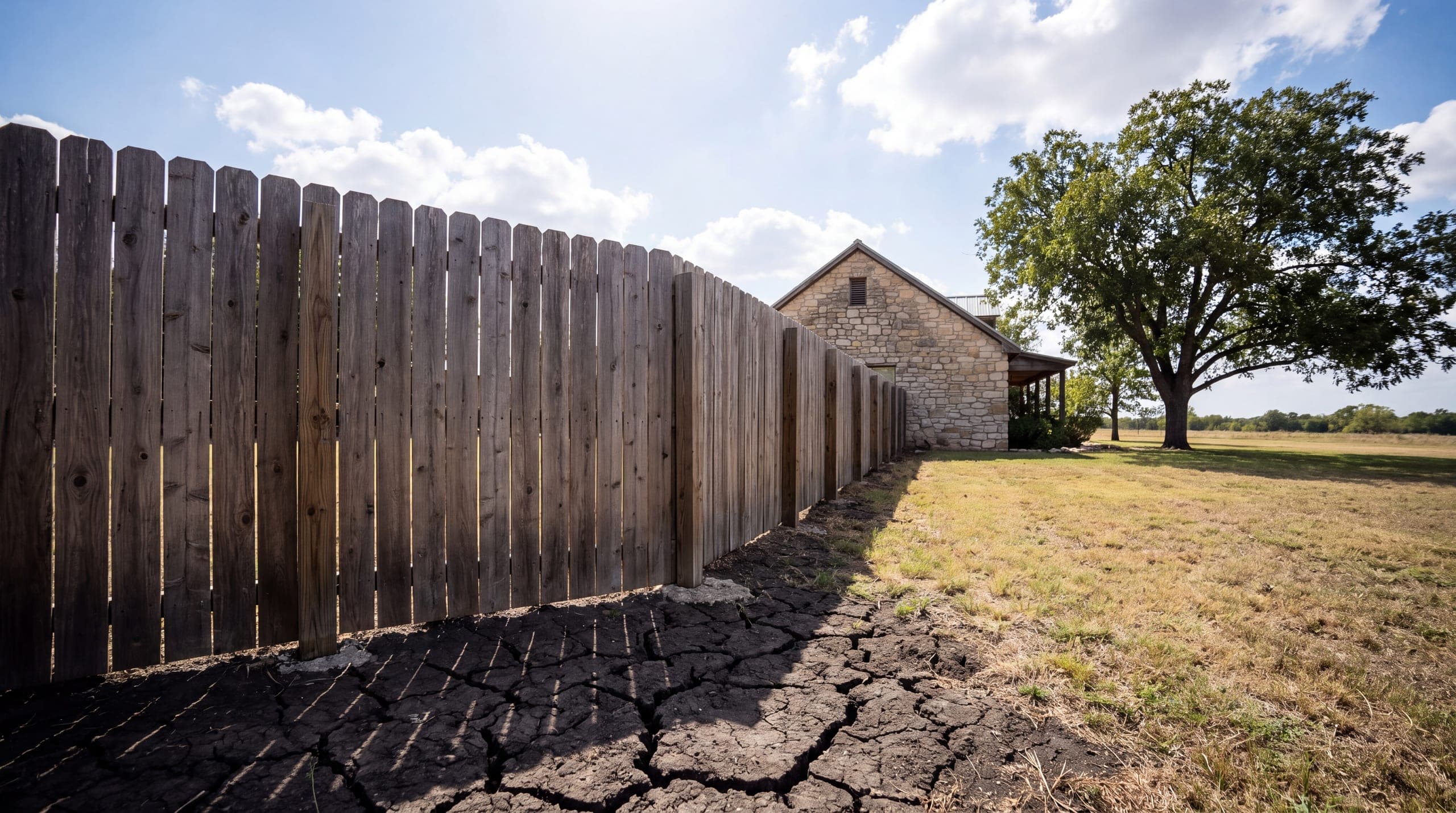
- Rocky or heavy clay soil. The Houston Black soil that runs the Blackland Prairie from Dallas south toward San Antonio is 60% to 80% clay with very high shrink-swell potential (USDA Natural Resources Conservation Service, 2023). Clay slows post holes and it moves posts later, so post depth and concrete belong on the page.
- Gates and automation. A gate is not a section of fence. It is a moving assembly with its own posts, hardware, and, if it is automated, an operator and safety sensors. Each gate opening should be priced as its own line.
- Permits and height. Houston requires a residential fence permit only when the fence goes over 8 feet above grade or is built wholly or partly of masonry or concrete, which needs a permit at any height (City of Houston, 2026). Other Texas cities set the trigger lower. The quote should say who determines this and who files it.
None of that is exotic. It is what a salesperson sees in fifteen minutes on your lot, which is why an on-site visit and a firm price are so closely related.
What Should a Fence Warranty on a Quote Cover?
Craftsmanship, in writing, with the term stated. Most fence warranties in Texas cover craftsmanship, and craftsmanship coverage is not material coverage. Texas has no statewide general-contractor or fence-contractor license; the state’s licensing authority regulates specific trades like electricians and HVAC, so a fence builder can operate statewide without one (Texas Department of Licensing and Regulation, 2026). With no state license standing behind the work, the written warranty is doing most of the work of protecting you.
So read it for three things. What it covers, how long it runs, and who you call.
Ours runs one year on craftsmanship. The number that matters more is what happened with it: across more than 20,000 projects last year, we had zero craftsmanship warranty callbacks. Materials are handled by spec instead of by promise, pressure-treated pine framing and cedar pickets, which is why the grade on the quote matters as much as the warranty under it. In a Google review, David H. wrote that Johnson “came in a fair price and delivered as promised. The quality of the materials is excellent and the installation was seamless.”
Should a Fence Quote Include a Start Date?
Yes, because a price you cannot schedule is not really a price. The fifth line on the page is how fast the quote turns into a crew in your driveway, and it is the line homeowners forget to ask about until the fence has been down for three weeks. Ask for the quote date, the expected start date, and how long the job runs once it starts.
Our own numbers, verified against our CRM: a logged lead gets a callback almost always the same day, a written quote goes out the same day on 95% of real leads, work starts within about 4 days of acceptance, and most residential jobs finish the day they start. That speed comes from crew depth. We run over 100 crews across Texas, 25 to 30 of them in Houston alone, where most fence companies run one to three. When a crew misses a day, your date still holds.
In a February 2026 Google review, Scott S. wrote: “Matt was awesome, The install went very well, i would recommend The Johnson Services Company to everyone.”