
Texas and Local

The Best Fence Company in Sugar Land, Texas for Iron and Masonry

Sugar Land's established homes buy ornamental iron and brick columns, not builder-grade pine. What that spec needs and how to compare the bids.

August 5, 2026

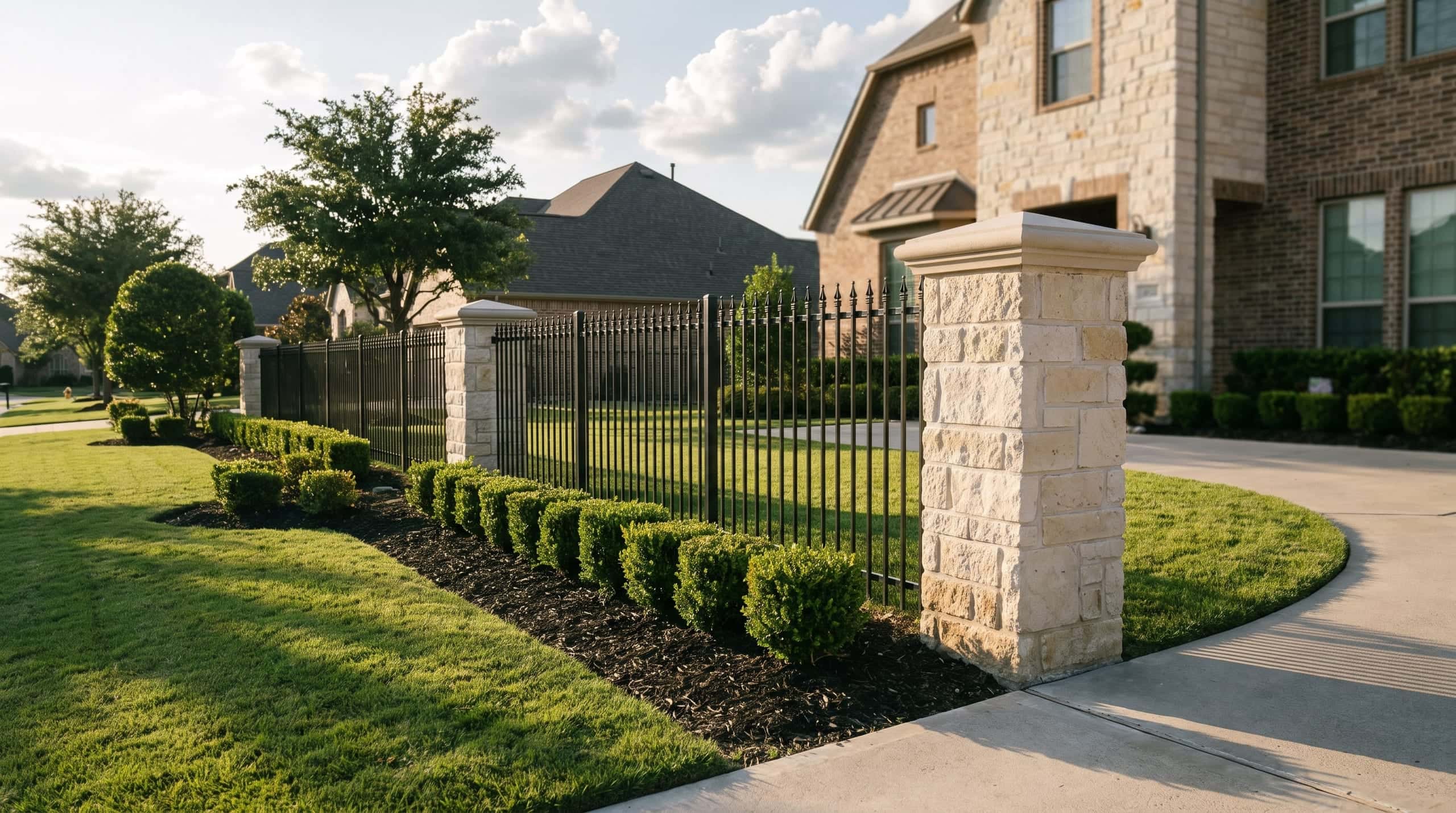
A pair of limestone columns with cast stone caps at a driveway, with iron panels leaving the outer column

A wrought iron fence in Sugar Land leans for the same reason a brick column cracks. The ground under it moves, and nobody sized the footing for that movement. Iron and masonry are the two lines where a fence stops being carpentry and turns into engineering, and most quotes say nothing at all about the part that decides how long it stands.

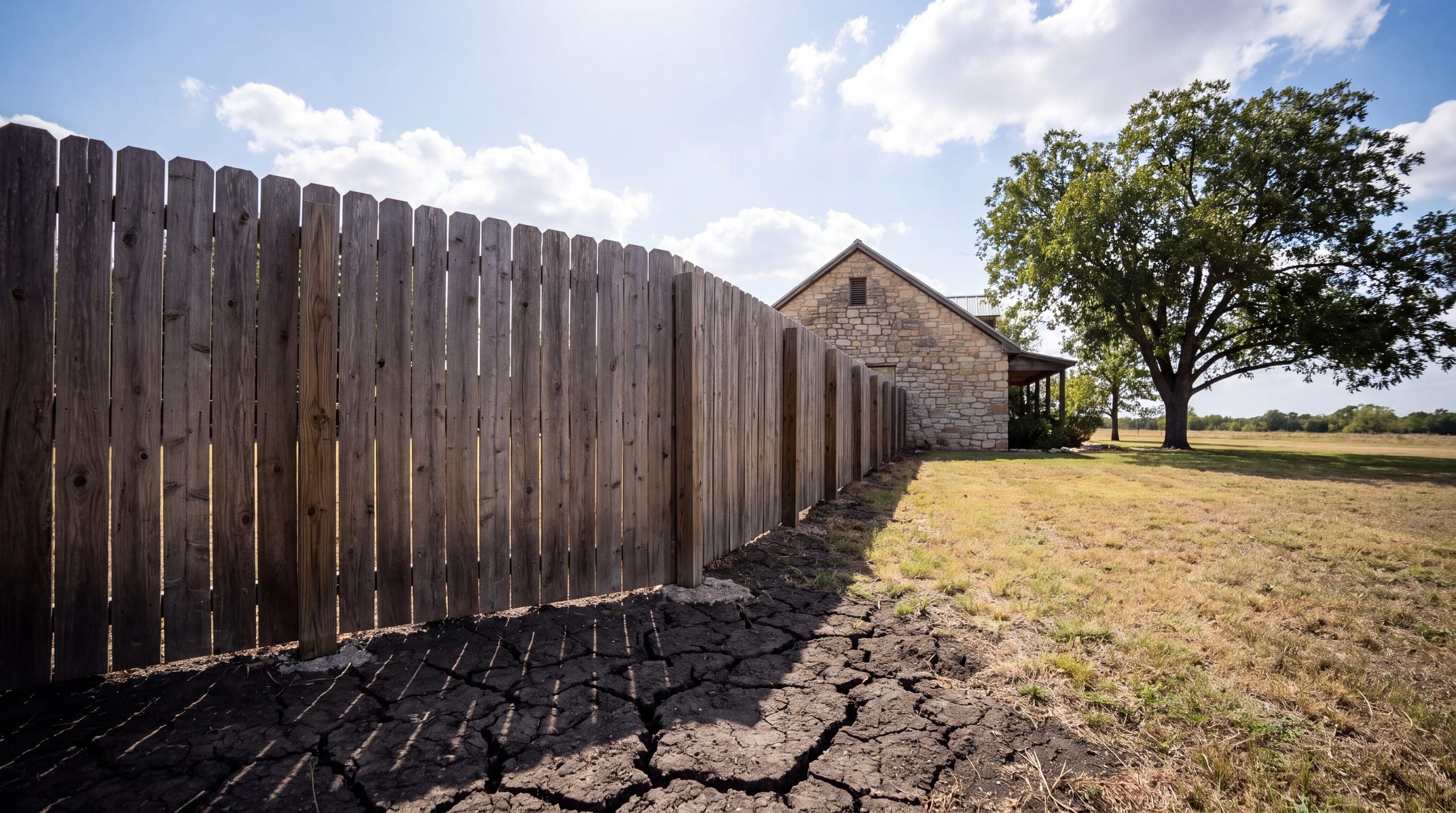
Sugar Land’s Clay Moves, and Your Fence Posts Move With It

Heavy clay swells when it gets wet and shrinks when it dries, and it drags whatever is buried in it along for the ride. The USDA classifies Texas Blackland clay as a Vertisol running about 60% to 80% clay, with shrink-swell so high that it lists the soil as a limit on building-site development (USDA NRCS, 2023). Sugar Land yards behave that way season after season, wet spring into cracked-open August.

That movement is expensive at scale. A landmark engineering assessment put damage from expansive soils on the order of $2.3 billion a year, more than the average yearly losses from floods, hurricanes, tornadoes, and earthquakes combined (Jones and Holtz, 1973).

Wood forgives some of this. A cedar picket fence racks a little, the pickets flex, and the eye never catches it. A welded iron panel and a mortared brick wall are rigid, so the soil wins the argument and you see it as a lean, a stair-step crack, or a gate that stops latching after the first hard freeze and thaw.

What Actually Holds Up an Iron or Masonry Fence

The part doing the work is underground. An iron panel weighs almost nothing next to the wind it catches, and the load runs panel to post, post to concrete, concrete to soil. Everything above grade is finish. The two numbers that decide the fence’s life are how big the footing is and how deep the post sits in it, and both should exist on paper before a crew shows up.

Term What it is Why it matters in Sugar Land clay
Footing The concrete mass around or under the post Spreads the load into soft clay so the post stops rocking
Embedment depth How far the post is buried below grade Sets how much soil resists the wind; too shallow means a lean
Vertical reinforcement Steel bar, often No. 4, run up inside a masonry wall Ties wall to footing so a crack does not become a failure
Grade SW facing brick Brick graded for severe weathering exposure Resists water soaking in and freezing at the face
Lateral load tier The design wind pressure in psf a wall is sized for Decides bar spacing and footing size on a masonry fence

Ask for the Embedment Depth Before You Ask for the Price

The 2021 International Building Code sizes a fence post like a cantilevered pole, and it lets the soil resist that load over only one-third of the embedded depth (2021 IBC, Section 1807.3.2.1). Required depth grows with the wind force and the height that force acts on, and it shrinks as soil gets stronger. Clay is weak soil. The same 6-foot iron fence needs a deeper, wider hole here than it needs in rock.

Three things set that number, and a company that engineers the work can tell you all three on the estimate:

  • Height above grade. Every extra foot of post lengthens the lever the wind pushes on.
  • The area the fence catches. A tight picket spacing or a privacy insert catches far more wind than an open iron rail.
  • The soil. Soft clay drives depth and width up, which is exactly the cost most low bids quietly leave out.

Gate posts are the first place this shows. Wind pressure peaks at ends, corners, and free edges, and a driveway gate hangs its whole weight off one post that also has to swing it a few thousand times. In an April 2026 Google review, Carlos M. wrote about an iron gate install: “The price was fair, the service was excellent, and everything was left clean once the job was done. Communication was great throughout the process, and they really took the time to go over the design with me before starting the work. Highly recommend.”

A Masonry Fence Is a Wall, and Walls Get Sized for Wind

The masonry industry’s prescriptive standard sizes cantilevered fence walls in lateral-load tiers of 15, 20, and 25 psf, and at 20 psf an 8-foot fence calls for No. 4 vertical bars at 16 to 24 inches on center over a 12-by-42-inch footing (NCMA/CMHA, 2007). Those are real dimensions with real cost. A quote for brick columns and a masonry wall that never mentions bar size or footing width was priced as decoration.

The wind side of it is not close. A fence counts as solid once its openings drop below 30% of the face area, and a solid freestanding wall is loaded across that entire face (ASCE/SEI 7-22, 2022). Open iron pickets let most of the air through. Brick and stone catch it all, so a wall and a fence on the same property line are two different engineering problems that happen to share a paint color.

Not Every Brick Survives a Texas Freeze

The masonry code that the building code points to specifies weathering-graded units, including ASTM C216 Grade SW severe-weathering facing brick and ASTM C90 concrete masonry units (TMS, 2022). Grade matters because a softer brick pulls water into its face. When that water freezes, the face spalls, and the wall starts shedding its skin in the fifth year instead of the fiftieth.

Specified correctly, masonry outlasts everything else on the property line. The Brick Industry Association estimates brick walls run 100 to 150-plus years before major repair, with mortar typically needing repointing at 50-plus years and sealant joints every 5 to 20 (Brick Industry Association, 2017). That is the return on a sized footing and the right brick. It is also why the cheap version stings so much: you paid for permanence and bought a repair schedule.

But Every Company Says They Set Posts in Concrete

The difference is whether they can hand you the numbers before install day. Anyone will say posts go in concrete. Very few will tell you how deep, how wide, what bar, what brick grade, and who files the permit, because saying it out loud means owning it later. Ask in that order and the field sorts itself out fast.

What to ask A real answer sounds like A warning sign
How deep will the posts sit? A depth in inches tied to fence height and clay soil “Standard depth” with no number
How wide is the footing, and what steel? Footing size plus bar size and spacing for a masonry wall Footing never mentioned in the quote
What brick grade? Severe weathering (SW) grade facing brick, named “Whatever brick you like”
Who handles the permit? They determine whether one is needed and file it “Fences don’t need permits”
Who owns the gate post and operator? One company sets post, gate, and operator as one system Fence crew installs, someone else motorizes

Two more things worth knowing before you sign. Texas has no statewide fence-contractor license, so nobody at the state level has vetted the truck in your driveway; you verify license, bond, and insurance yourself, and you ask for proof in writing. And small work tells you as much as big work. In a March 2026 Google review, Jon B. wrote: “Johnson fence did a great job replacing/repairing several of our fence posts and kick boards. This was a small but necessary job that several fence companies refused to do. Johnson fence company did a fantastic job for a fair price.”
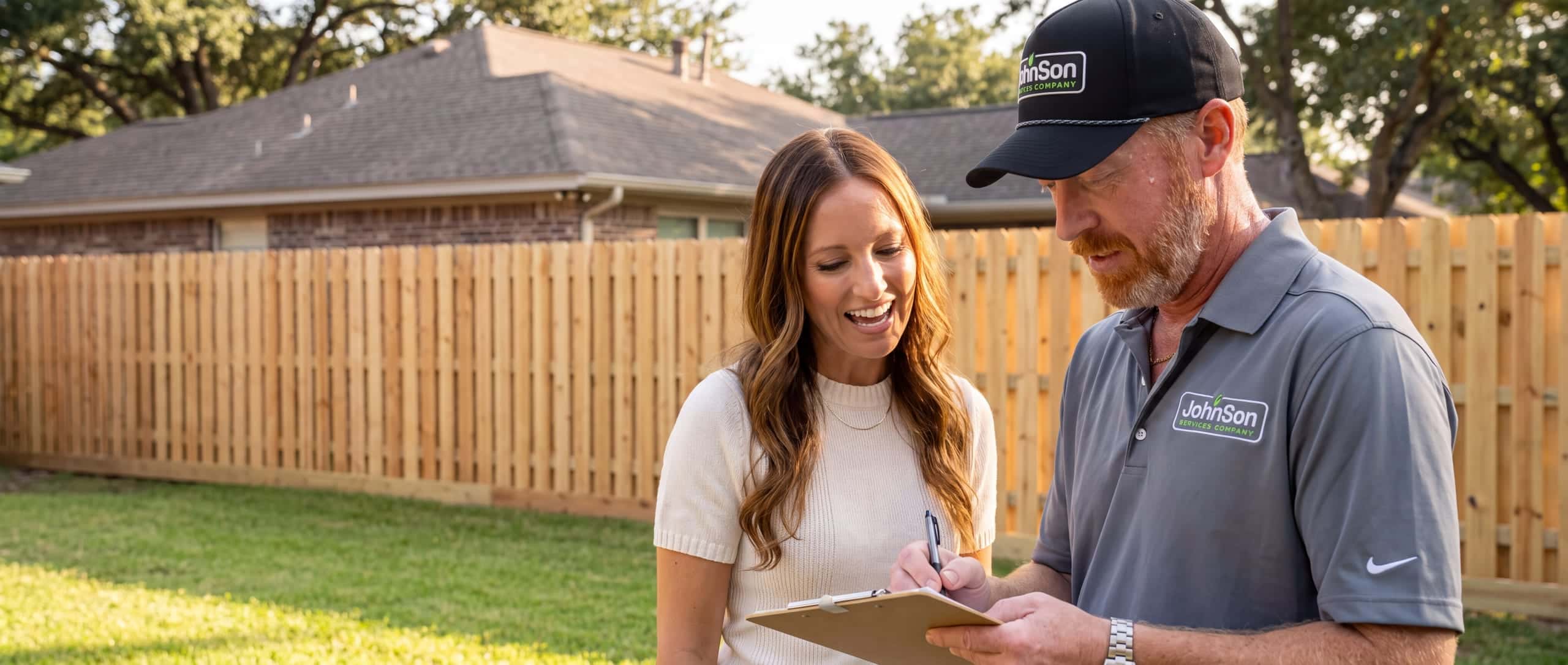
A Johnson estimator writing a fence quote on a clipboard beside a homeowner.

Price a fence before you call

See what a fence costs before anyone quotes you.

Pick the material, the height and how many feet of fence, and the calculator shows the market range for a fence like yours in Texas. Then a salesperson measures the real one in your yard and the number comes back the same day.

The estimate is free and there is nothing to sign.

So Hire the Company That Measures the Job Before It Prices It

Iron and masonry reward the boring work: a measured site, a sized footing, a specified brick, a crew that shows up with the right materials already loaded. That discipline is what over 100 crews in the field is for, because a job that was measured and specified up front does not need a decision improvised on install day.

Your project What to weigh hardest The question that settles it
Brick columns in an HOA neighborhood Brick grade, footing size, front-yard setback rules “Show me the footing detail and the brick grade”
Long iron run on shifting clay Post embedment depth and post spacing “How deep, and why that depth here?”
Automatic driveway gate Gate post footing plus operator and sensors as one system “Who is accountable if the gate sags in a year?”
A fence that failed too early Whether the original spec or the install caused it “What was wrong with the last one?”

The pitch you should distrust is the one that opens with style. The one worth hearing opens with the ground. In a June 2026 Google review of wrought iron repair work, Vi G. wrote: “We are very satisfied with the finished work. It was done skillfully and neatly. Office personnel are accommodating.”

Where We Sit Among the Fence Companies Serving Sugar Land

Iron and masonry sit at the edge of what a fence contractor normally carries, and the companies serving this side of Houston split into those with a stone and brick line and those who subcontract it or skip it. Here is how the options compare on the material lines they publish, how gates and permits get handled, and how far their service reaches.

Company Iron and masonry lines published Gates and permits Service area published
Johnson Services Company Iron and aluminum, brick and stone, custom stone columns, plus a dedicated Tomball masonry office Determines and files commercial permits; installs gate operators to UL325 42 Texas cities across Houston, Dallas-Fort Worth, Austin, San Antonio
Texas Fence Iron, vinyl, chain link, wood and cedar; no brick or stone line listed Driveway gates and access control Houston and surrounding areas
Southland Fence & Supply Wood, iron, vinyl, chain link, and brick-and-stone fencing, plus a fence-supply store Driveway gates Houston metro
Best Fence Company Wood, chain link, iron, cap and trim, good neighbor; no masonry line listed Iron fence and gate repair and installation Metro Houston, with Sugar Land named

Rows are the fence contractors publishing service to Sugar Land and the west side of the Houston metro; companies whose published maps cover the southeast Gulf Coast suburbs instead are a different market. Best Fence Company states on its own site that it understands the construction requirements Texas extreme weather demands, and lists Sugar Land, Missouri City, Stafford, and Richmond among the communities it builds in.

Frequently Asked Questions

Can I put a brick fence in my front yard in Sugar Land?

It depends on your subdivision’s covenants and the city’s rules, so confirm both before you buy materials. Since September 1, 2025, a Texas property owners’ association cannot prohibit a perimeter fence or other security measure, though it keeps limited say over type and material, can require a driveway gate to sit at least 10 feet back from a laned right-of-way, and can bar fencing forward of the front building line (Texas Property Code, 2025).

Is wrought iron or masonry better for a backyard on clay?

Iron is the lighter load on moving soil, because open pickets pass most of the wind and the posts carry less force into the clay. Masonry outlives it by decades when the footing and reinforcement are sized for the wall, which is why the honest comparison is iron done right against masonry done right.

How long does an iron or masonry fence take to install?

Many residential fences are scheduled quickly and installed in as little as a day, while masonry runs longer because footings and mortar need cure time. Permit review and custom stone columns add days on the front end, and we give you the date before we start.

Can leaning iron panels be repaired, or is it a full replacement?

If the panels and welds are sound, the fix is usually resetting the posts and footings that moved rather than replacing the fence. Replacement becomes the better buy when the coating has failed at grade and rust has eaten into the post itself.

Does a masonry fence need an engineer?

Prescriptive standards cover common heights and load tiers, so a straightforward wall can be built to a published detail. Taller walls, unusual geometry, and anything the city flags in review are where a stamped design earns its cost.

Why does my iron fence rust at the bottom of the posts first?

Water sits at grade, and grade is where coatings get scratched during install and later by trimmers. A multi-stage pretreatment with an epoxy coat and topcoat, plus a footing that drains, is what keeps that zone from becoming the first failure.

Is financing available for iron or masonry work?

Yes. We price every project by custom quote after a free on-site estimate, and we offer financing in manageable monthly payments for both residential and commercial work.

How Johnson Services Company Sizes the Footing Before It Prices the Fence

Iron and stone fail from the ground up, so we measure every job and specify the materials and crews before anyone leaves the yard. Customers rate us 4.9 stars across 60 Google reviews. In a June 2026 Google review, Carmen G. wrote: “The crew at Johnson Services Company provided outstanding service at a very competitive price.” Part of that value comes from the yard, not the labor: Johnson Services Company is Master Halco’s largest-volume customer for wood pickets in 2026, and that buying power means a picket cost most competitors simply don’t get. We pass that through, so an iron or masonry job that includes wood-picket sections comes in lower for the same construction; the same fence for less, because the wood costs less.

We have been building in Texas since 2002 and installed more than 2 million feet of fence across more than 20,000 completed projects in the last twelve months, out of seven offices covering 42 cities and towns. That volume is why the brick, the iron, the gate operator, and the masonry crew all come from one accountable company with an A+ BBB rating held since 2003. Across that same 20,000-plus jobs last year, we logged zero craftsmanship warranty callbacks; a 100% record, not a promise about what happens next. It stands behind a one-year warranty on craftsmanship, covering our labor and installation; it is not a material warranty. What customers name most often in reviews is the crew and the schedule, and the numbers back it up: a same-day callback on your inquiry, a quote the same day on 95% of real leads, work starting within about 4 days, and most jobs finished in a single day. In a June 2026 Google review, Randy R. wrote: “The fence was installed in just 2 days and looks great! The job site was cleaned up well b4 the crew left.”


Johnson Services Company treats iron and masonry as the engineered work Sugar Land’s clay makes it, footing and embedment sized before the quote goes out. Call (877) 956-4676 or request a free on-site estimate, and we will walk the property line with you.

Get a free on-site estimate for your iron or masonry fence →

Free estimate

Get your estimate from the largest fence company in Texas

Tell us what you need and where the fence goes, and a salesperson will come out and measure the line before anyone writes a number. You get the picket grade and the total in writing, the visit costs nothing, and there is nothing to sign.

Call (877) 956-4676

Monday to Friday, 7am to 4pm.

What kind of fence?
Which part of Texas?
Roughly how much fence?
How did you hear about us?
  • Free on-site estimate
  • Same-day quote
  • Nothing to sign
  • Work starts in about 4 days