
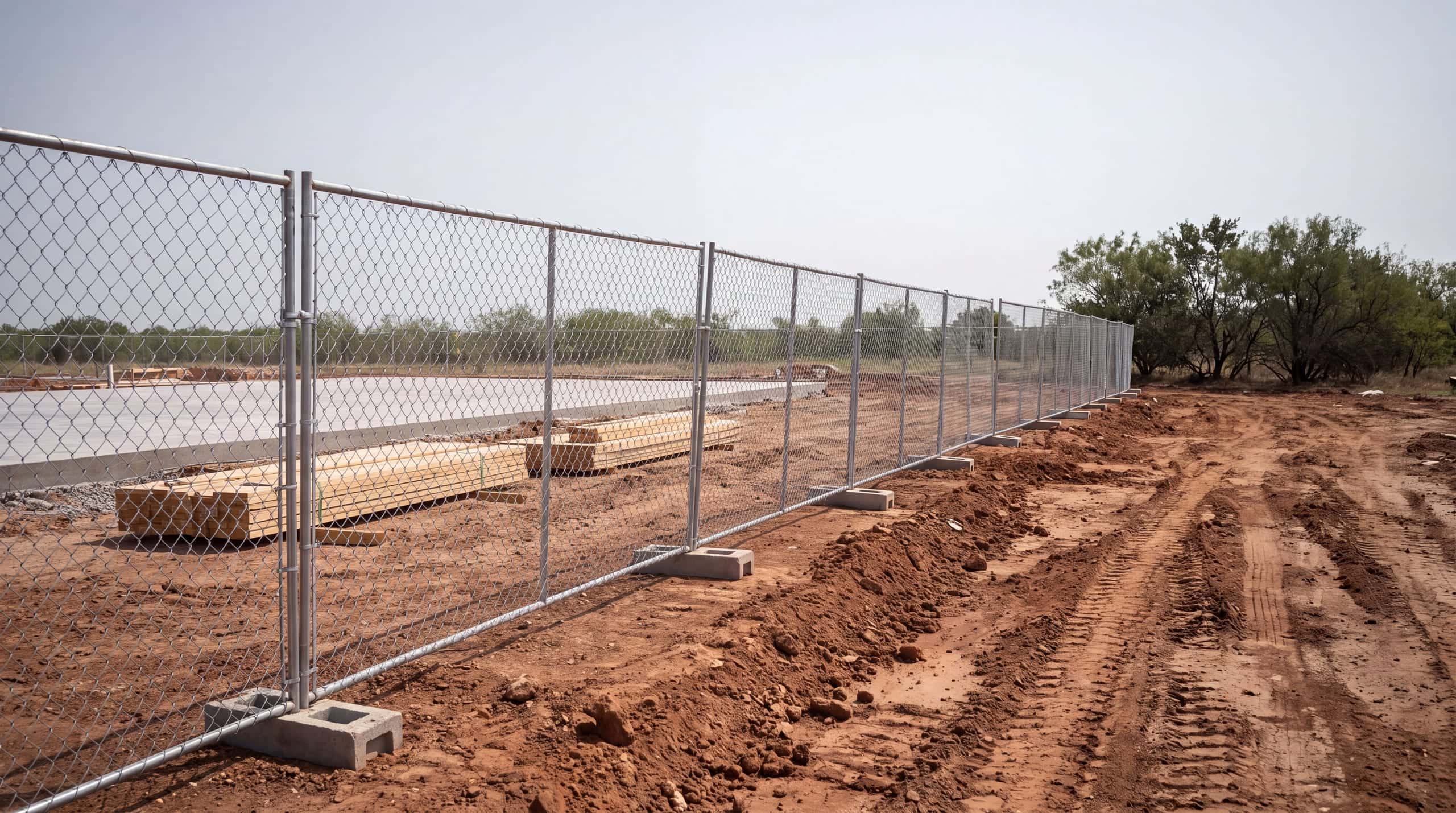
Temporary construction fencing buys time, not security. Rented panels mark the line, slow casual trespassers and satisfy the OSHA rule that a site with open trenches or heavy machinery be secured (29 CFR 1926.502), but they are not engineered for a Gulf Coast design wind, and by the second rental cycle they cost more than the permanent fence the property needs anyway.
The perimeter is a compliance deadline before it is a security choice, and it lands earlier in the schedule than most builders plan for.
When Does a Texas Construction Site Need a Fence?
The day the first trench opens or the first machine arrives. The obligation starts with the hazard, so the fence is due the moment a machine rolls onto the pad. Texas Johns puts 2026 fines for willful violations at up to $15,000 per day. Per day is the part builders miss. A perimeter you planned to handle next week is already accruing exposure this week, and an inspector does not care that the fence sub is booked.
Site security is the second reason to fence, and it is the one that actually gets budgeted. Copper, generators, and skid steers walk off open sites. The compliance clock arrives first, though, and it arrives on a date nobody negotiates.
What Is Temporary Construction Fencing Good For?
Rented panels buy you speed and portability, which is exactly what a moving job site needs. Texas Johns describes temporary construction fencing as free-standing, self-supporting panels held together with couplers, typically in 6-foot or 8-foot heights, built from galvanized steel that resists the humid Gulf Coast air in Houston and the dry heat of West Texas. That is a real product doing a real job, and on the right project it is the correct call.
Four things panels are genuinely good at:
- Same-week deployment. A crew sets a run in hours because nothing gets dug. No post holes, no concrete, no cure time.
- No permit in most Texas cities. A panel line under the local height limit moves without a filing.
- Coverage that moves with the work. When the pad shifts or a lay-down yard relocates, the couplers come apart and the line follows.
- Galvanized steel that survives the season. Zinc coating handles Houston humidity for the length of a build.
What they are not good at is standing still for a year in Texas wind, and they are not the finished perimeter your plat already promised.
Does a Construction Fence Need a Permit in Texas?
Most construction fence lines clear the permit threshold without a filing, and the threshold changes by city. The building code exempts fences not over 7 feet from a permit, and that exemption never suspends the physics: IBC Section 1609 still requires wind loads to be determined per ASCE 7 (2021 International Residential Code, 2021). A permit-free fence still has to stand up.
Here is where the line sits in the four metros we work in.
| City | Where the permit line falls | What still applies |
|---|---|---|
| Houston | Permit required only above 8 feet, or at any height for masonry or concrete | Wind design governs even on a permit-exempt wood or metal fence |
| Dallas | No fence in a required yard above 9 feet; front-yard fences capped at 4 feet in most residential districts | A Dallas building permit is required above the by-right limits |
| Austin | Permit-exempt to 7 feet outside floodplains; required above 7 feet or in a floodplain at any height | A solid fence on a property line is capped at 6 feet from natural grade |
| San Antonio | Side and rear yards 6 feet, 8 feet with a code exception; front-yard solid fences capped at 3 feet | Any fence over 8 feet needs an engineer’s wind-load certification |
Commercial and development sites get determined project by project. We handle that determination and file the permit when a project needs one.
How Should Temporary Fence Panels Be Braced?
Brace long panel lines every 50 feet, because they fail sideways. Texas Johns recommends adding V-bracing or perpendicular panels every 50 feet on long panel lines to increase lateral stability, and posting Danger, Construction Area or No Trespassing signs every 30 feet. Both numbers are cheap. Both get skipped.
The bracing advice has research behind it. Full-scale wall testing at Silsoe established that wind pressure on a freestanding wall is highest near its free ends and leading edge, and is strongly reduced by return corners (Robertson and Hoxey, 1996). A perpendicular panel is a return corner. It is the same reason the end panels and the tall posts flanking a gate are the first things to move in a storm.
Two more habits worth the labor. Sandbag or tie down every base foot on the windward run, and walk the line after every wind event instead of after the next inspection.
Can Temporary Fencing Stand Up to Gulf Coast Wind?
Not to a design wind event. Panels on freestanding feet are not engineered for a Texas design wind event. ASCE/SEI 7-22 maps the Houston metropolitan area at basic design wind speeds on the order of 130 to 140 mph for ordinary structures in Exposure C, rising toward 150 mph at the immediate Gulf shoreline (ASCE/SEI 7-22, 2022). Nothing sitting on a rubber foot is designed against that number.
The porosity is what decides how hard the wind hits. Wind-tunnel testing found a wall standing on the ground carries a normal-force coefficient of about 1.45 that is nearly independent of its length (Letchford, 2001). Chain link mesh lets most of that air through. Staple a privacy screen or a wind screen across the same panels and you have built a solid wall, because ASCE 7 counts a fence as solid once its openings drop under 30% of gross face area. Screens are the single most common way a construction fence gets blown flat.
A permanent line answers the same wind differently. Posts get embedded in concrete and sized as cantilevered poles under the building code, with embedment depth driven by the wind force, its lever arm, and how weak the soil is. In Houston Black clay that means a deeper, wider footing. That is the difference between a fence that leans and a fence that stays.
When Does a Permanent Fence Cost Less Than Renting Panels?
Usually by the second rental cycle. The crossover comes sooner than most builders assume, because Texas build windows are long. Single-family completions averaged 9.1 months from authorization to completion in 2024, and 7.6 months from permit to completion on homes built for sale (U.S. Census Bureau, 2025). A panel rental carried across nine months, re-set twice as the site changes, then removed so the real fence can go in, is the same perimeter paid for twice.
Not every site should install early. A pad with heavy equipment working all four sides will chew up a finished fence, and renting through that phase is correct. The question is whether every side of the site stays that way, and usually one or two runs settle early: the back line against an easement, the street frontage that will carry the monument, the stretch nobody drives a machine across again.
| Situation on your site | What it points to | Why |
|---|---|---|
| Build window under 4 months, equipment working all sides | Rent panels for the full run | A finished fence gets damaged before handover |
| Build window past 6 months with settled boundary lines | Set the permanent fence on the settled runs early | A second rental cycle costs more than that install |
| Coastal site with hurricane season inside the schedule | Permanent embedded posts on the exposed run | Panels on freestanding feet move first in design wind |
| Subdivision with perimeter fence and monument in the plat | Build the permanent perimeter, rent panels inside it | The perimeter is scope you already bought |
Price is part of this, so here is our part of it. We are Master Halco’s largest-volume customer, holding the 2026 Largest Volume Customer awards for the Southwest Region and the World, and a top customer of Solid Wood. That buying power is a picket cost smaller contractors do not get, and we pass it through. You get the same spec for less, and we name the picket grade, #1 through #3, on the quote instead of letting a grade quietly slip.