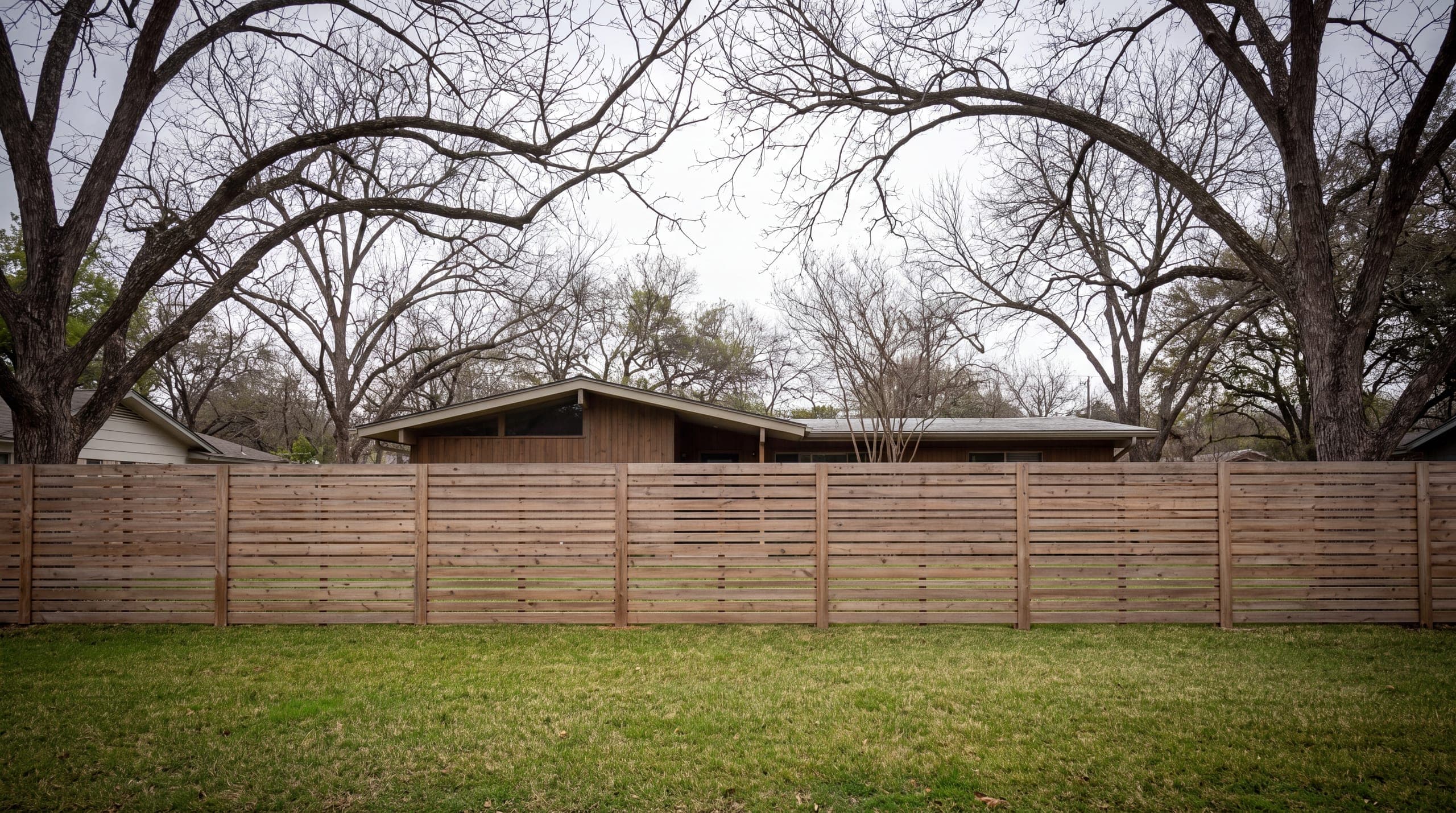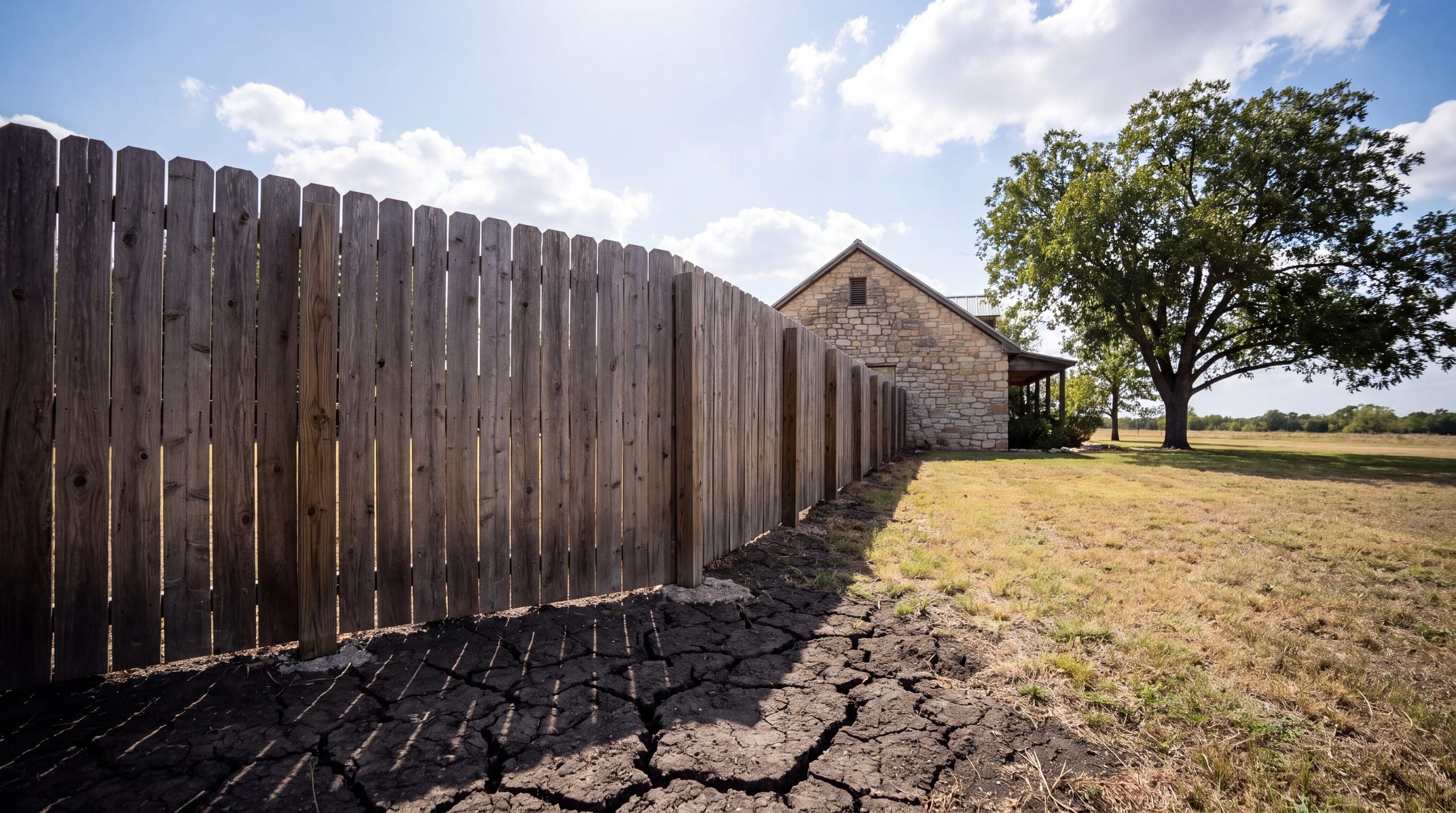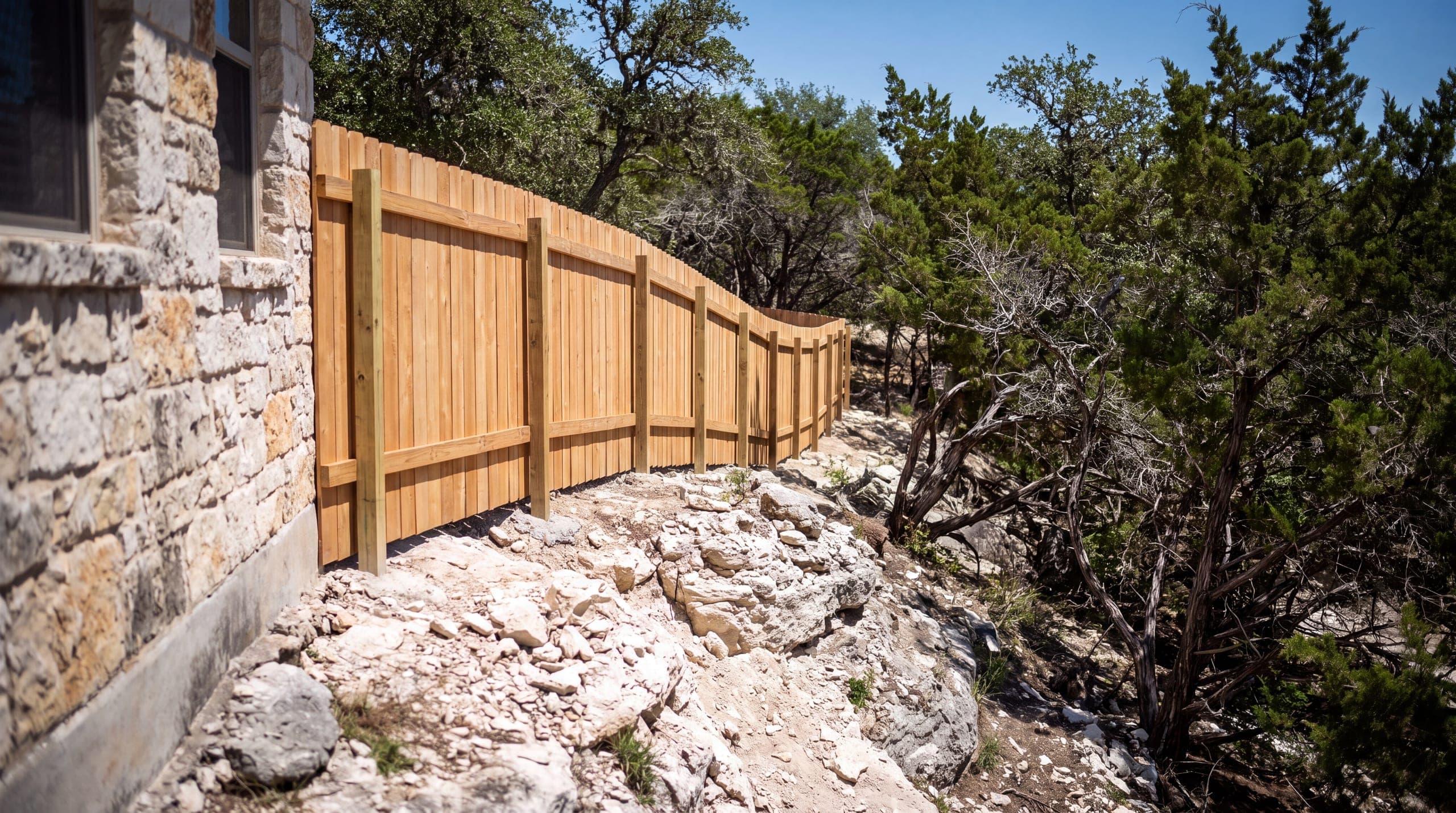

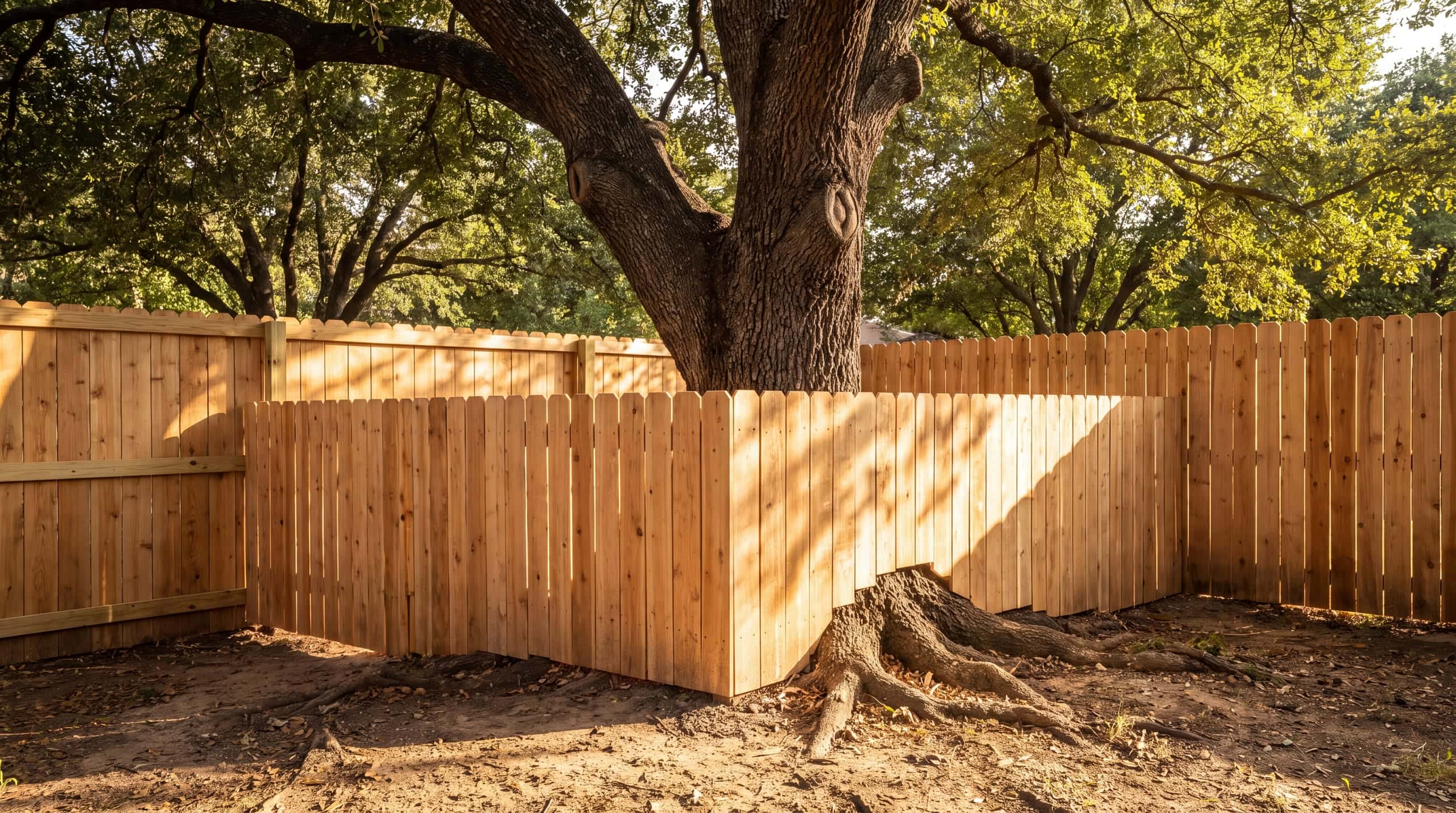
A builder lot is graded dirt. A thirty-year-old lot has live oaks standing on the fence line, irrigation laterals a few inches under it, and forty years of roots in between, which is what makes replacing that fence the harder job. The trees decide the layout, the post placement, and the removal method before anyone picks up a digger, and you can judge a contractor’s whole plan on whether they walked those trunks with you first.
An Established Lot Is Harder to Fence Than a Builder Lot
Trees and irrigation are the reason. On a builder lot a crew runs a straight line and sets every post the same way, because nothing is in the ground yet. On an established lot there are mature live oaks on the line, sprinkler heads and lateral lines just below grade, and an old fence that has to come out without hurting either one.
That is the job our founder built the company on: go into a 30-year-old home, tear out the entire old fence, put in a brand new one. We installed more than 2 million feet of fence last year across more than 20,000 projects, and the replacement work on lots like these is the part that takes planning rather than speed.
It is also the work people get turned down for. In a March 2026 Google review, Jon B. wrote: “Johnson fence did a great job replacing/repairing several of our fence posts and kick boards. This was a small but necessary job that several fence companies refused to do. Johnson fence company did a fantastic job for a fair price.”
Know These Terms Before You Read a Tree-Line Fence Quote
Five words carry every decision a crew makes near a tree. Learn them and you can read a quote the way an estimator reads a yard, because each one names a place on the property where the fence has to give way to the tree instead of the other way around.
| Term | What it means | Why it decides the fence |
|---|---|---|
| Root flare | Where the trunk widens out into the ground at its base | Posts, rails, and hardware all stay outside it |
| Drip line | The circle on the ground under the outer edge of the canopy | Most feeder roots sit inside that ring, so digging changes there |
| Feeder roots | The fine roots in the top foot of soil that take up water | One pass with a trenching machine cuts thousands of them |
| Boxing out | Framing posts around a trunk so no part touches bark | Keeps the fence line continuous while the tree keeps growing |
| Embedment | How deep the post sits in the ground below grade | A shallow hole near roots becomes a leaning post after two storms |
Never Bolt a Fence to a Tree Trunk
Nothing goes into the bark. Eastcoast Fence puts the rule plainly: never attach the fence to the tree, because screws, nails, and brackets damage bark and can invite pests. A trunk also adds diameter every year, so a bracket that clears the wood today gets swallowed by it later.
There is a load problem too. A solid privacy fence catches close to the whole wind, and wind tunnel testing measured a force coefficient of about 1.45 on a wall standing on the ground (Letchford, 2001). Bolt a fence panel to a live oak and every gust in a Texas spring pulls against the bark.
The tree moves, and the fence does not. Even a well-built panel tied to a trunk will work at the attachment point until something splits. Free-standing posts on both sides of the tree solve it for good.
Box Out the Root Zone Instead of Cutting Through It
Move the post, keep the depth. Fence posts are sized as cantilevered poles, and the required embedment grows with the wind force and its lever arm, which is why a shallow hole near a root is never the fix (International Building Code, 2021). Post spacing has some give in it. Root position has none.
- Dig by hand inside the drip line. Anywhere under the canopy, a shovel and a bar tell you what an auger would only find out by cutting.
- Slide the post, do not sever the root. Shortening one bay and lengthening the next costs a few minutes and saves a structural root.
- Keep concrete off the flare. Footings sit clear of the widening base of the trunk, so the tree has room to grow into over the next twenty years.
- Box out rather than pierce. Posts frame the trunk on both sides with an air gap, and the fence stays continuous without touching wood.
Pick One of Three Layouts Where the Line Meets a Trunk
Every tree on the line gets a named layout before pricing. There are only a few honest ways to pass a mature trunk, and each one trades something: yard space, a small opening, or extra labor. A boxed-out corner also needs deeper posts, because full-scale wall testing found wind pressure is highest at free ends and leading edges (Robertson and Hoxey, 1996).
| Layout | What the crew builds | What you give up |
|---|---|---|
| Boxed-out corner | Posts framing a square around the trunk, with no contact on the bark | Two extra corners, each needing deeper posts against wind |
| Straight run with a gap | The line runs past the trunk and leaves a small opening at the bark | An opening a small dog can use |
| Framed opening | Panels stop and start at a header, framing the trunk as a feature | Custom cuts and framing, so more labor on that bay |
| Rerouted line | The whole run moves a few feet to clear the canopy edge | Yard space, plus a boundary conversation if the tree is shared |
But Removal Day Does More Root Damage Than Install Day
The old fence comes out first, and that is where trees get hurt. A truck pulling an old post with roots wrapped around the footing takes the roots with it. Heavy equipment on wet ground packs the soil around the feeder roots, and the Blackland Prairie soil running from Dallas south to San Antonio is 60% to 80% clay with very high shrink and swell (NRCS, 2023).
- Cut the post, leave the footing. Where roots have grown around an old concrete plug, taking that plug out costs more tree than it saves in labor.
- Stay off the root zone. Material moves in by hand under the canopy, and machines stay on the open part of the yard.
- Flag irrigation before the first hole. Heads and lateral lines get located at the walk, because a sprinkler line and a fence line want the same few inches of dirt.
Why a Shaded Fence Line Rots Faster Than a Sunny One
Shade keeps the wood wet. Houston scores 77.2 on the decay hazard index, deep inside the high band, and the same index puts Dallas at 44.3 (USDA Forest Products Laboratory, 2009). A fence line under a full canopy sits in the worst end of that number all year.
Decay needs water, not just time. Serious fungal decay takes hold when wood holds moisture above about 30%, and air-dried lumber that stays near 20% carries a real margin of safety (USDA Forest Products Laboratory, 2021). Under a live oak the fence dries slowly, leaf litter piles at the base, and the bottom of every picket stays damp days longer than the sunny run across the yard.
So the tree changes the spec, not only the layout. On a shaded line the picket grade, the kickboard, and the post treatment all matter more than they do on an open lot, and the quote should name each one.