
Guides

How to Dig Fence Post Holes in Caliche Soil in Austin, Texas

Caliche is hard to dig, but a rented breaker with a spade bit and a pilot path gets post holes to full depth. Here is how to do it in Austin.

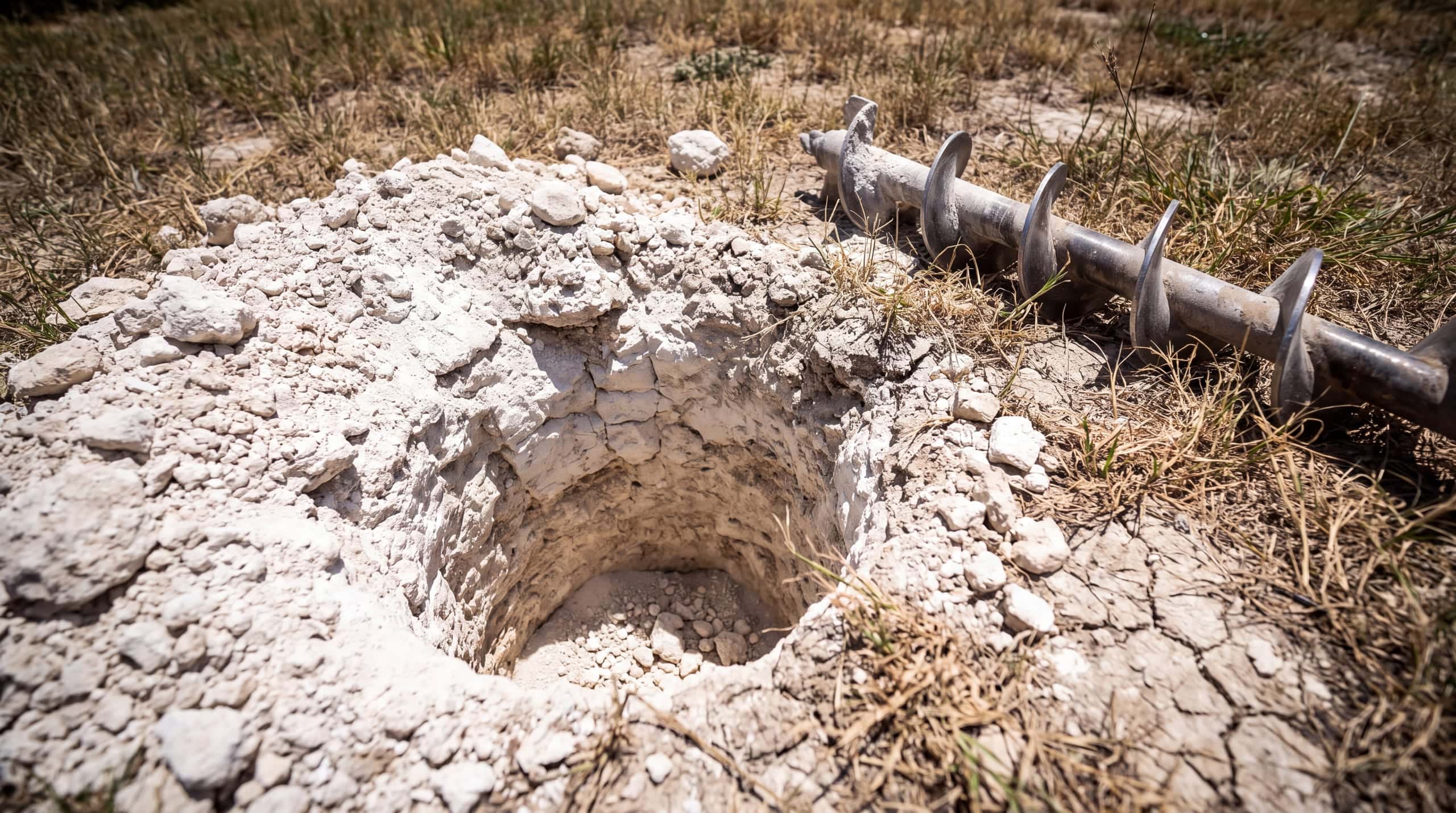
A freshly augered post hole cut into white caliche and fractured limestone

Break the caliche with a rented electric breaker fitted with a spade bit and a heavy digging bar. Then clear the loosened rock with a narrow spade or a wet/dry shop vacuum, and repeat until the hole reaches full depth. Caliche acts like concrete, so a pickaxe or plain post hole digger bounces off until you chip a pilot path.

That is the easy part to say and the hard part to do across a whole fence line. The homeowners who get burned in Austin are the ones with a fence that failed too soon, a quote that left out the picket grade, or a crew that never came back. The steps below cover the digging yourself, and the later sections show when to hand it to a crew.

What should you do before digging fence post holes in Austin?

Request a utility locate through Texas811 before you break ground, because Texas law requires three business days of notice to the 8-1-1 one-call center before an excavation, down to a mailbox post (U.S. Department of Labor (OSHA), 2023). Then clear the topsoil and mark the exact center of every post hole, since caliche leaves no room to correct a bad start.

Once a breaker bit walks off the mark, you are chipping a second hole beside the first one. Mark each center with paint or a stake, and score the spot so the bit has a place to seat.

The layer you are marking sits shallow. On the Eckrant soil series, common on Texas Hill Country plateaus, limestone bedrock lies 4 to 20 inches down (USDA Natural Resources Conservation Service (NRCS), 2018). On a mapped Tarpley clay unit in Hays County, fractured limestone bedrock was measured at 17 to 21 inches (Texas State University, 2000). Either way, the rock starts well above the bottom of a fence post hole.

What tools do you need to dig post holes in caliche?

Rent a medium-to-heavy electric jackhammer or roto-hammer with a narrow spade or chisel bit, and bring a heavy steel digging bar to crack loosened chunks. Add a post hole spud or narrow trenching spade, a wet/dry shop vacuum for gravel and dust, and a water hose for stubborn layers.

A hardware store like The Home Depot rents the breaker. Pick the narrow spade or chisel bit, because a wide bit makes a wide hole, and a wide hole costs you more concrete later.

The rest of the kit has one job each. The digging bar fractures what the breaker loosens. The spud or narrow trenching spade scoops out the fractured material. The shop vacuum pulls loose gravel, dust and muddy crumbs from deep in the hole, where a spade cannot reach. The hose softens a layer that will not give.

Put it all in one trip. A breaker returned for a missing bit costs you the afternoon.

How do you break through caliche in a fence post hole?

Run the breaker or slam the digging bar into the marked center to fracture the caliche, chipping a pilot path first. Then alternate breaking with scooping out the rubble using a narrow spade or shop vacuum. Soak the cracks with water for a few hours if the layer is stubborn, without turning the hole to mud that traps your tools.

The pilot path matters because manual pickaxes bounce off an unbroken surface. Once the bit has chipped a small channel, the next strike has something to bite. Use the jackhammer, or lift the digging bar and drop it into the center again and again, until the calcified minerals crack.

Do not let the rubble pile up. Break, clear, break, clear. Each pass lowers the floor of the hole a little, and a clean floor shows you where the next strike should land.

Water helps when the rock turns stubborn. Pour it, or a mild water-vinegar solution, into the cracks and give it a few hours to soften the dense clay that binds the caliche. Stop short of a total mud soup, because mud grips a bar and a spade and makes both harder to pull out.

How deep and wide should a fence post hole be?

A six-foot wood privacy fence needs a post hole at least 2 feet deep, with a diameter about 3 times the width of the post, according to QUIKRETE’s Setting Posts without Mixing instructions. For a 4-inch wood post, that means a hole about 12 inches wide.

QUIKRETE gives the depth rule as 1/3 to 1/2 of the post height above ground. Its Setting Posts data sheet adds a second rule, which is 1/3 of the overall post length plus 6 inches for the gravel base. Use the deeper of the two answers for your posts.

Those depths run past the soil layers in the first section, so every hole on a six-foot fence goes through caliche or limestone. That is why a short hole is a real risk. A hole stopped at 1 foot because the rock got hard leaves a post that cannot hold the fence.

If your digger handles keep hitting the tight upper walls, widen the top opening a few extra inches. That gives your tools room to open and bite deeper.

When we price a fence, the footage gets measured on site and the picket grade (#1 through #3) is named on the quote. The price follows the measured footage and the picket grade you pick, charged per linear foot.

When should you hire out caliche post hole digging in Austin?

A whole fence line, deep holes or a firm install date point to a crew, and the number of holes and their depth decide it. How many holes you need and how deep they must go settles whether renting heavy machinery or digging by hand makes more sense.

Do the sum before you rent. Count the posts on your line, multiply by the depth from the last section, and picture each hole as a pass of breaking and clearing. One or two holes for a mailbox post suit a weekend. A property line of them does not.

The cost of a crew that cuts corners is real too. A one-star Google review of Austex Fence & Deck from May 26, 2026 reads: “The post should be 2 feet underground but they only did 1 feet. I cannot imagine a fence professional company could do something like that. Now my fence is in bad condition and it is leaning because of that and they are not willing to come back to fix it.”

That reviewer describes one job where a post went in at half the depth. Ask any crew you hire to write the post depth on the quote, then hold them to it.
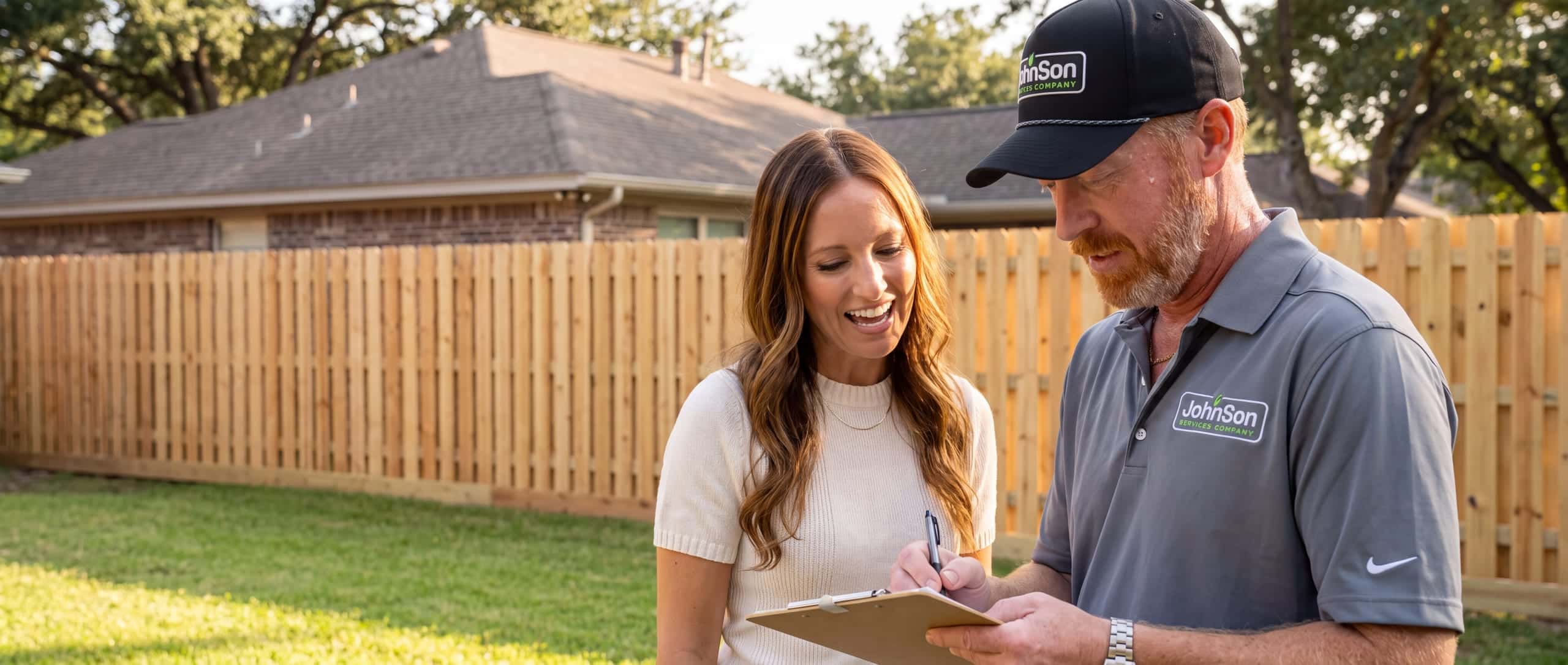
A Johnson estimator writing a fence quote on a clipboard beside a homeowner.

Price a fence before you call

See what a fence costs before anyone quotes you.

Pick the material, the height and how many feet of fence, and the calculator shows the market range for a fence like yours in Texas. Then a salesperson measures the real one in your yard and the number comes back the same day.

The estimate is free and there is nothing to sign.

Which Austin fence companies can take over the digging for you?

Austex Fence & Deck serves the Austin metro and Central Texas, and Johnson Fence covers Austin as one of its four Texas metros. The table lists each company’s markets, crew counts and build details, so you can weigh who covers Austin and who can hold a start date on a full fence line.

Company Texas markets served Crews in the field Published build or warranty detail
Johnson Fence Houston, Dallas-Fort Worth, Austin, San Antonio metros; 42 cities and towns statewide Over 100 crews in the field In business since 2002; A+ BBB rating since 2003; one-year craftsmanship warranty; zero craftsmanship warranty callbacks across 20,000-plus jobs last year
Texas Fence Houston metro and surrounding areas over 20 crews In business since 2003; more than 30,000 fences built; 30 full-time staff
Quality Fence & Welding San Antonio metro; South Texas Crew count not published In business since 1980; 5-acre facility; 29,000 square foot steel fabrication shop
Austex Fence & Deck Austin metro; Central Texas Crew count not published 30+ years serving Central Texas; claims 200,000-plus projects; full materials showroom

Each company’s markets, crew counts and build details come from its own published statements.

Texas Fence lists the Houston metro and Quality Fence & Welding lists San Antonio and South Texas, so neither names Austin. For an Austin line, the two names in the Austin metro column are Austex Fence & Deck and us.

Johnson Fence measures your Austin yard and puts the post depth on the quote

Johnson Fence has over 100 crews in the field, so a crew missing a day never stops a job. That crew depth, plus a one-year craftsmanship warranty and zero craftsmanship warranty callbacks across 20,000-plus jobs last year, is what holds your start date.

Here is how a job starts. On site, our salesperson measures the linear footage and confirms the fence type and picket grade with you. The grade (#1, #2 or #3) is named in writing on the quote, so you know what you are buying before a post goes in. The estimate is free.

We measure every job in advance and stand behind what we build. We run multiple crews for reliability, which matters because the backyard fence is the last trade on site before a home can close. The wood-picket buying power we hold goes to our customers, so you pay less for the same spec, not less for a thinner one.

In an August 2025 review on Google, Celeste T. gave five stars and wrote: “Excellent experience beginning to end! Wouldn’t hesitate to use them again or recommend to others! Options were presented to work within our budget. Supervisor confirmed timeline, crew arrived promptly, confirmed work scope, worked efficiently and left the property clean. Fence didn’t budge an inch when severe storms came through the next day!”

FAQ

Can you use a regular post hole digger in caliche?

No. Caliche acts like concrete, so manual pickaxes bounce off until you chip a pilot path. Break that path with a breaker or a heavy digging bar first. Then a narrow spade or spud can scoop out what you loosened.

How long should you let water soak into caliche?

Let it soak for a few hours. Pour water, or a mild water-vinegar solution, into the fractured cracks so it softens the dense clay that binds the rock. Keep it from becoming a total mud soup that traps your tools.

Does a fence need a permit in Austin?

Permits are rarely required for a fence. Where a project does need one, our team handles the permit determination and the filing. A residential fence rarely needs one.

What do you do when a post hole turns to mud?

Pull the water out with a wet/dry shop vacuum, which sucks loose gravel, dust and muddy crumbs from deep in the hole. Then go back to breaking and clearing. Next time, soak the cracks for only a few hours, because a total mud soup traps your tools.

How do you widen a post hole when your digger handles bind?

Widen the top opening of the hole a few extra inches. If the handles keep hitting the tight upper walls, the extra room lets the tool open and bite deeper. Leave the lower hole narrow.

What should you ask a fence company about digging through rock?

Ask who measures the job on site, and ask for the picket grade and the post depth in writing. We name the grade (#1 through #3) on the quote, and pricing is per linear foot, set by that footage and the grade you choose.

What does a one-year craftsmanship warranty cover on a fence?

The one-year warranty we give covers craftsmanship only, not materials. It is the only warranty we carry. Last year’s 20,000-plus jobs produced zero craftsmanship warranty callbacks.

What does a wood fence cost per foot installed in Texas?

HomeCostGuide’s 2026 figure for a professionally installed 6-foot wood privacy fence is $25 to $60 per linear foot, with the typical cost about $38 per foot. Homewyse’s 2026 estimated national average for a wood privacy fence starts at $33.07 to $53.00 per linear foot. Those are market ranges from those publishers. Our price comes from the footage measured on your yard and the picket grade you choose.


Johnson Fence sends a salesperson to measure your Austin fence line and writes the picket grade on the quote, so the digging is priced before a crew arrives.

Request your Austin fence estimate →

Free estimate

Get your estimate from the largest fence company in Texas

Tell us what you need and where the fence goes, and a salesperson will come out and measure the line before anyone writes a number. You get the picket grade and the total in writing, the visit costs nothing, and there is nothing to sign.

Call (877) 956-4676

Estimate requests get a reply 24 hours a day, 7 days a week.

What kind of fence?
Which part of Texas?
Roughly how much fence?
How did you hear about us?
  • Free on-site estimate
  • Same-day quote
  • Nothing to sign
  • Work starts in about 4 days