
Texas and Local

How to Decide Between Fence Repair and Full Replacement in Texas

The ground line tells you what a fence needs. Eye level rarely does.

August 6, 2026

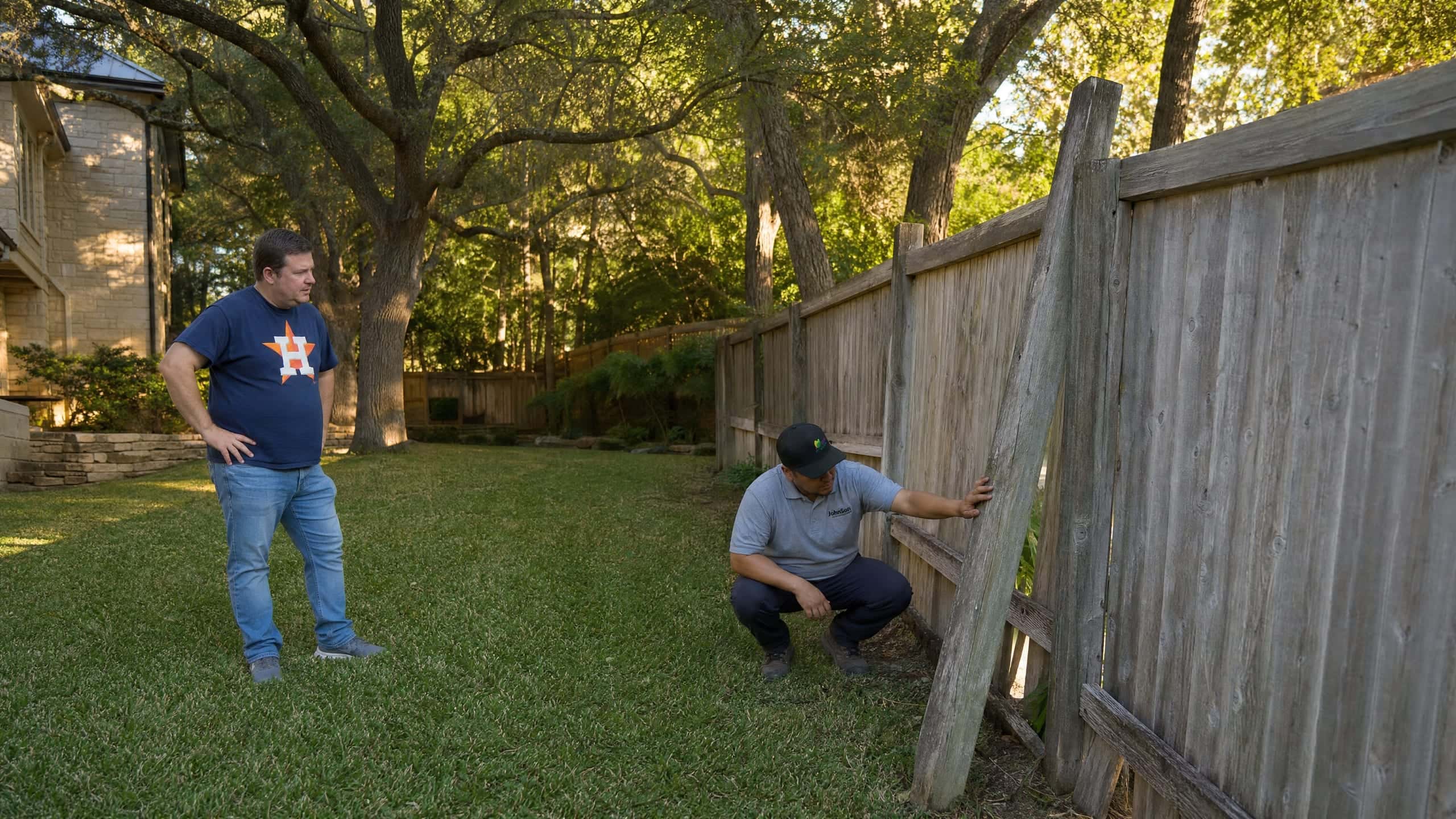
A crew lead checking a leaning post on a tired cedar fence with the homeowner watching

The ground line tells you what a fence needs. Eye level rarely does. Most repair-or-replace advice compares two prices, and in Texas that comparison starts in the wrong place, because the condition of the wood at the bottom of your posts has usually already decided the answer. Dig at one post before you take a bid.

Check the Post at the Ground Line Before You Price Anything

Push on a panel. If the post moves and the pickets stay put, the post has already failed, whatever the boards look like from your patio. Wood only rots when it stays wet, and serious decay needs a moisture content above the fiber saturation point, an average of 30%, while air-dried wood usually holds at or under 20% (USDA Forest Products Laboratory, 2021). The bottom few inches of a buried post never get to dry out.

That is why the inspection happens down low. Four checks tell you almost everything before anyone quotes you.

  • The screwdriver test. Push a screwdriver into the post at the soil line. If it sinks in past a quarter inch with hand pressure, that post is spent.
  • The lean test. Grab the post itself and rock it, leaving the pickets alone. Movement at the base means the wood or the concrete collar has given up.
  • The ground line ring. Look for a dark, soft band right where the post meets the dirt. Rot starts there and works up.
  • The count. Walk the whole run and test every post, including the far corners. The number of bad posts is the decision.

A homeowner who tests two posts and stops has not inspected a fence. They have sampled it.

The Repair-or-Replace Rule Holds, With One Texas Correction

Isolated damage on a young fence is a repair, and spread damage on an older one is a replacement. Griffin Fence draws that line at 1 to 3 boards, a single post, or gate hardware on a fence under 12 years old that is otherwise sound. It calls for replacement when multiple posts have failed, when 30% or more of the boards are damaged, or when the lean runs across several sections.

That rule is right, and we use the same one. The correction is that age means different things in different parts of Texas. A 12-year-old fence in Dallas and a 12-year-old fence in Kingwood are not the same fence, because the ground under them is doing different work.

There is a money line too. Griffin Fence puts it at 50%: once the repair estimate passes half the cost of a full replacement, replacement is the better buy. We agree, with one addition. Compare the repair to a replacement that is actually specified correctly, or you are comparing your repair to the same fence that just failed on you.

What “Ground Contact” and “Heartwood” Mean on a Fence Bid

The words on a bid decide how long the new fence lasts, and two of them do most of the work. The wood-preservation industry’s Standard U1 puts fence posts in Use Category 4A, general ground contact, and sets a minimum preservative retention for long-term service in soil (American Wood Protection Association, Standard U1). A post treated to a deck-rail retention and put in the dirt is a post that will rot early.

Term on the bid What it actually means Why it decides repair or replace
Ground contact (UC4A) Preservative retention specified for wood buried in soil A post below this retention fails at the ground line first, no matter what the pickets cost
Heartwood vs sapwood The dark inner wood resists decay; the pale outer wood does not Cedar pickets cut mostly from sapwood gray out and rot years early
Ground line The band where post, soil, and air meet Nearly every wood fence failure in Texas starts in this 4-inch band
Embedment How deep the post sits in concrete below grade Shallow embedment shows up as seasonal lean while the wood stays sound
Picket grade (#1 to #3) The grade of the picket, by knots and defects A bid that says “cedar” without a grade number is not yet a spec

Ask which grade of picket a repair quote is using. A repair that mixes a #3 picket into a #1 fence is visible from the street in a year.

How Fast Wood Fails Depends on Which Texas Metro You Are In

The federal decay hazard index puts Houston at 77.2 and Dallas at 44.3, which is the difference between the high-hazard band and the middle of the moderate one (USDA Forest Products Laboratory, 2009). Same state, same species, very different clock. Houston humidity keeps the ground line damp for more of the year, and damp is the only condition rot needs.

Texas metro Decay hazard index Where that sits Source
Houston 77.2 High hazard band, above the 65 threshold USDA FPL, 2009
Austin 55.2 Moderate band (35 to 65) USDA FPL, 2009
San Antonio 52.2 Moderate band (35 to 65) USDA FPL, 2009
Dallas 44.3 Moderate band, lowest of the four metros USDA FPL, 2009

Read the age rule through that column. A Houston fence at 10 years deserves a hard post inspection before anyone spends a dollar on repairs, because the ground line has been working on those posts the whole time. A Dallas fence at 10 years more often has good posts and tired pickets, which is a genuine repair.

Clay Moves the Post Even When the Wood Is Sound

Not every failed post is a rotted post. Houston Black, the Texas state soil, runs about 60% to 80% clay and carries very high shrink-swell potential across the Blackland Prairie from Dallas south to San Antonio (USDA Natural Resources Conservation Service, 2023). It swells wet and shrinks dry, every year, and it pulls on anything set in it.

The signature is a fence that tilts a little more each season and stands up straighter after a wet spell. Corners and gate posts go first, because they carry the most load and have the least help from neighbors. If you pull one of those posts and the wood is clean but the concrete collar is loose in the hole, the fix is a deeper hole and a bigger footing. Preservative will not touch it.

That distinction changes the repair. Resetting a clay-heaved post at the same depth in the same hole buys you two seasons. Resetting it deeper, in a properly sized footing, is real work that costs real money, and once three or four posts need it, the arithmetic has already tipped.

But Repairing Half a Fence Buys You Half a Fence’s Life

A repair only resets the clock on the parts you touched. Griffin Fence prices a post replacement at $200 to $400 including labor and concrete, and gate hardware at $75 to $200. Three posts and a gate on a fence whose remaining posts are the same age, in the same soil, is most of a thousand dollars spent on a fence that will ask again next year.

What you find on the walk The call Why
One loose post, the rest solid Repair that post Isolated failure, no pattern along the line
Three or more loose posts along the run Replace the fence The remaining posts are the same age in the same soil
Soft rot ring at the ground line on spot-checked posts Replace the fence Rot at the ground line runs the whole line
Gray, cupped pickets over sound posts Repair or reface the pickets The part that failed is the part that is cheap to change
Repair estimate nearing half a replacement estimate Replace the fence You are paying half price for none of the service life

Price is exactly why we push people toward the honest version of this comparison. We are Master Halco’s largest-volume customer, holder of their 2026 Largest Volume Customer awards for the Southwest Region and the World, and a top customer of Solid Wood. That buying power sets our picket cost, and we pass it through. It is the reason a correctly specified replacement from us often lands closer to a patchwork repair than homeowners expect, at the same grade of wood, named on the quote.
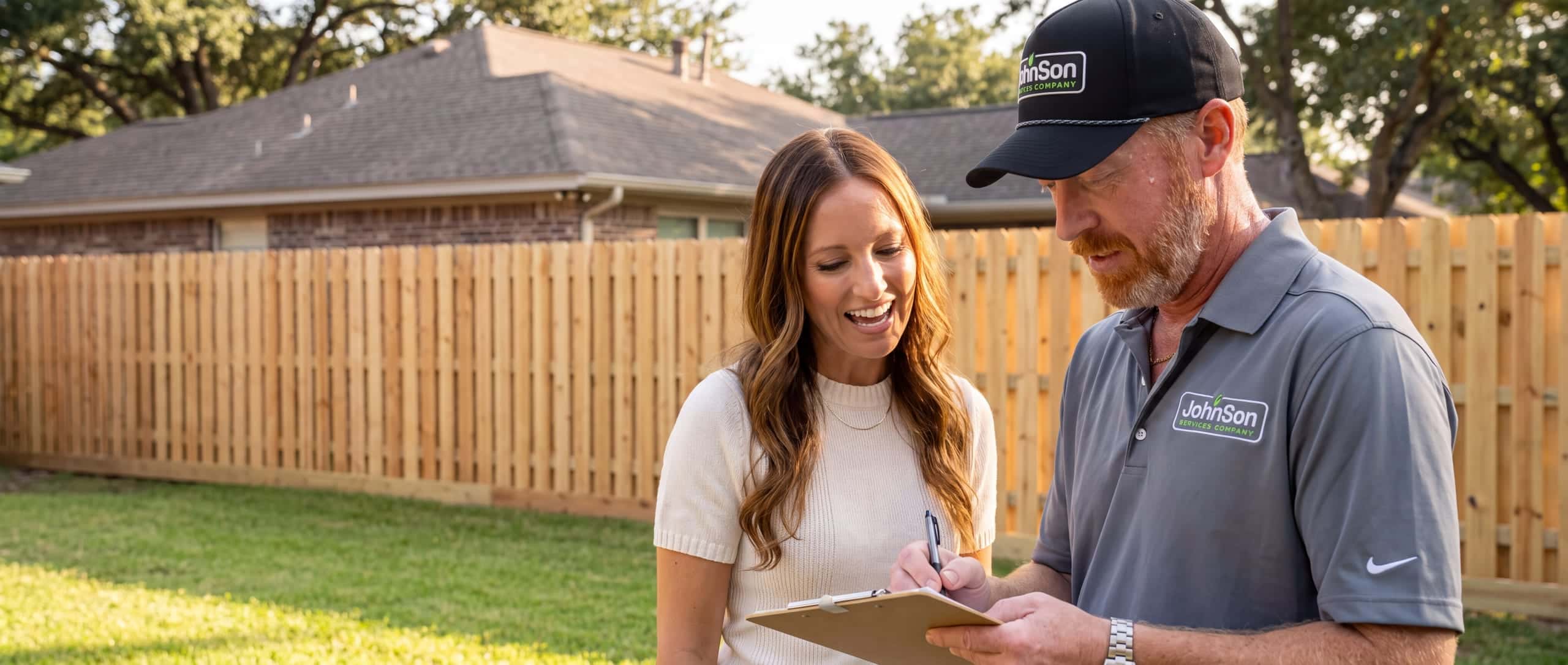
A Johnson estimator writing a fence quote on a clipboard beside a homeowner.

Price a fence before you call

See what a fence costs before anyone quotes you.

Pick the material, the height and how many feet of fence, and the calculator shows the market range for a fence like yours in Texas. Then a salesperson measures the real one in your yard and the number comes back the same day.

The estimate is free and there is nothing to sign.

What a Replacement Quote Should Name, Line by Line

A replacement that does not change the spec just schedules the same failure. In a severe-exposure in-ground test in southern Mississippi, pressure-treated wood showed expected durability beyond 60 years, while untreated stakes in the same soil lasted a year to a few years (USDA Forest Products Laboratory, 2013). Treatment is the difference, and it belongs on paper.

  • Post material and treatment. Pressure-treated pine specified for ground contact. The bid should say so in words.
  • Embedment and footing. The building code sizes a fence post as a cantilevered pole, with embedment growing as the wind load and its lever arm grow and shrinking as the soil gets stronger (2021 International Building Code, Section 1807.3.2.1). In soft clay that means a deeper, wider concrete footing, and the quote should name the depth.
  • Picket grade by number. #1, #2, or #3. Cedar or pine. Written down.
  • Post spacing. The distance between posts, stated in feet, so nobody stretches the run to save four posts.
  • Gate posts. Sized and set separately from line posts, because they carry the swing and the wind.
  • Removal and haul-off. Old fence out, concrete out, debris gone. This is where surprise charges live.

Get those six lines right and the storms answer for you. In a review on our site, Celeste T. wrote: “Fence didn’t budge an inch when severe storms came through the next day!” We put more than 2 million feet of fence in the ground last year across more than 20,000 projects, and we had zero craftsmanship warranty callbacks on that work.

So Dig at One Post Before You Compare the Two Prices

The two numbers on your kitchen table are the last step. Post condition, the decay hazard of your metro, and how far the damage has spread will tell you which side of the line your fence sits on, and they will tell you before anyone hands you a price. When one post is loose on a young fence, repair it and move on. When the posts are going along the run, or the repair quote creeps toward half of replacement, you are buying time at full price.

Texas makes that call earlier than most states do. High decay hazard on the Gulf side and clay that moves under the whole middle of the state mean a fence can look fine at eye level and be finished at the ground line. Test the posts first.

Where Johnson Sits Among Houston-Area Fence Contractors

A replacement is decided at the post, and the contractor you call has to have the crews and the coverage to do that work on a date they promised. Here is how we compare with the established Houston-area contractors that publish their own scale, on metros served, crew depth, and what else they can handle on the same property.

Company Texas metros served Crews in the field Beyond fence installation
Johnson Services Company Houston, Dallas-Fort Worth, Austin, San Antonio (42 cities and towns) Over 100 crews statewide, 25 to 30 in Houston Gates and operators, decks, gazebos, masonry, landscaping, irrigation
Texas Fence Houston and surrounding areas Over 20 crews and 30 full-time staff Driveway gates and access control, HOA and pool fencing
Southland Fence & Supply Houston metro Not published Fence-supply store alongside installation, driveway gates
Bayou City Fence Company Southeast Houston and Gulf Coast: League City, Pearland, Friendswood, Clear Lake, Galveston Not published Custom gates and access control, 36-inch concrete footings

Frequently Asked Questions

Can you replace just the fence posts and keep the pickets?

Yes, when the pickets are sound and the failure is limited to a post or two. The crew pulls the panel, sets a new post in a new footing, and rehangs the boards. It stops being worth it once several posts along the same run need the same treatment.

How much does it cost to replace one fence post in Texas?

Griffin Fence puts post replacement at $200 to $400 including labor and concrete, and gate hardware at $75 to $200. Our own work is quoted per job after we measure it on site, because a post in rocky clay behind a mature live oak is not the same job as a post on an open lot.

How long should a new wood fence last in Texas?

InterNACHI’s life-expectancy chart rates a wood fence at about 20 years, and that is a national figure. On the Gulf side of Texas, where decay hazard runs high, the posts decide whether you get near that number, which is why ground-contact treatment and footing depth belong on the quote.

Do I need a permit to replace a fence in Houston?

Not for an ordinary wood or metal fence 8 feet or under. Houston requires a residential fence permit only above 8 feet, or at any height when the fence is built wholly or partly of masonry or concrete. Austin, Dallas, and San Antonio each set their own limits, and we check the local rule before we quote.

Should I replace my fence one section at a time to spread the cost?

Only when the sections genuinely differ in age or condition. Splitting one fence line of the same vintage into phases usually means paying mobilization twice and living with a color mismatch, because new pickets and four-year-old pickets never match.

My fence leans a little more every year. Is that rot?

Often it is the clay, not the wood. Pull one post and look at it: clean wood in a loose concrete collar points to soil movement and a footing that is too shallow or too small, while a soft dark band at the soil line points to decay.

How fast can a replacement actually start?

We get a rough estimate to you over the phone from your address, then measure on site, and a quote goes out the same day on 95% of real leads. Work starts within about 4 days of the quote being accepted, and most residential fences finish the same day they start.

Johnson Services Company Quotes Replacements Same Day, Starts Within 4 Days

The whole point of inspecting at the post is that it changes what you should buy, and you cannot act on that until somebody comes out and measures. Members of our market rate us 4.9 stars across 60 Google reviews. What customers name most often is the speed of the callback and the price on the page. In a June 2026 Google review, Randy R. wrote: “Their price was competitive and lower than the other 2 but what sealed the deal was Matt called back the same day I initially contacted them for an appraisal.”

Our salesperson measures the linear footage, confirms fence type and picket grade with you, and writes the spec down, because that is the document that decides whether the new fence outlives the old one. Behind that quote sit over 100 crews, 25 to 30 of them in Houston, so the install date we give you is a date we can keep. In a May 2026 Google review, Jess C. described the work as “Awesome high quality workmanship and timely.”

We are also the ones who will tell you to repair instead of replace when that is the right answer. A fence with one bad post and 11 good ones does not need a proposal from us for a whole new run.


Johnson Services Company is who to call when you need the post inspected before the price, on a fence you are not sure is worth saving. Get a free on-site estimate, with financing available if you want it, at any address across our four Texas metros.

Get a free on-site fence estimate →

Free estimate

Get your estimate from the largest fence company in Texas

Tell us what you need and where the fence goes, and a salesperson will come out and measure the line before anyone writes a number. You get the picket grade and the total in writing, the visit costs nothing, and there is nothing to sign.

Call (877) 956-4676

Monday to Friday, 7am to 4pm.

What kind of fence?
Which part of Texas?
Roughly how much fence?
How did you hear about us?
  • Free on-site estimate
  • Same-day quote
  • Nothing to sign
  • Work starts in about 4 days