
Replacing a fence is not the same job as building one. A crew has to tear out a failed line, work around live oaks and buried irrigation, and set a spec on a lot nobody measured carefully the first time. So the questions you ask a replacement contractor are different from the ones a builder asks an installer on an empty lot.
A Replacement Is a Harder Job Than a New-Build Fence
The hard part happens before the first new post goes in. A builder lot is flat, clear, and empty, with no old fence to demolish and nothing planted along the line. An established home is the opposite, and the three things that make it harder are the same three things that blow up a schedule when a contractor has not planned for them.
- The trees. Mature live oaks sit right on the property line in most Texas backyards. Removal and post holes both have to happen without wrecking roots.
- The irrigation. Sprinkler lines run inches from the old fence on a lot that has been landscaped for 20 years. A crew that digs blind will find them the expensive way.
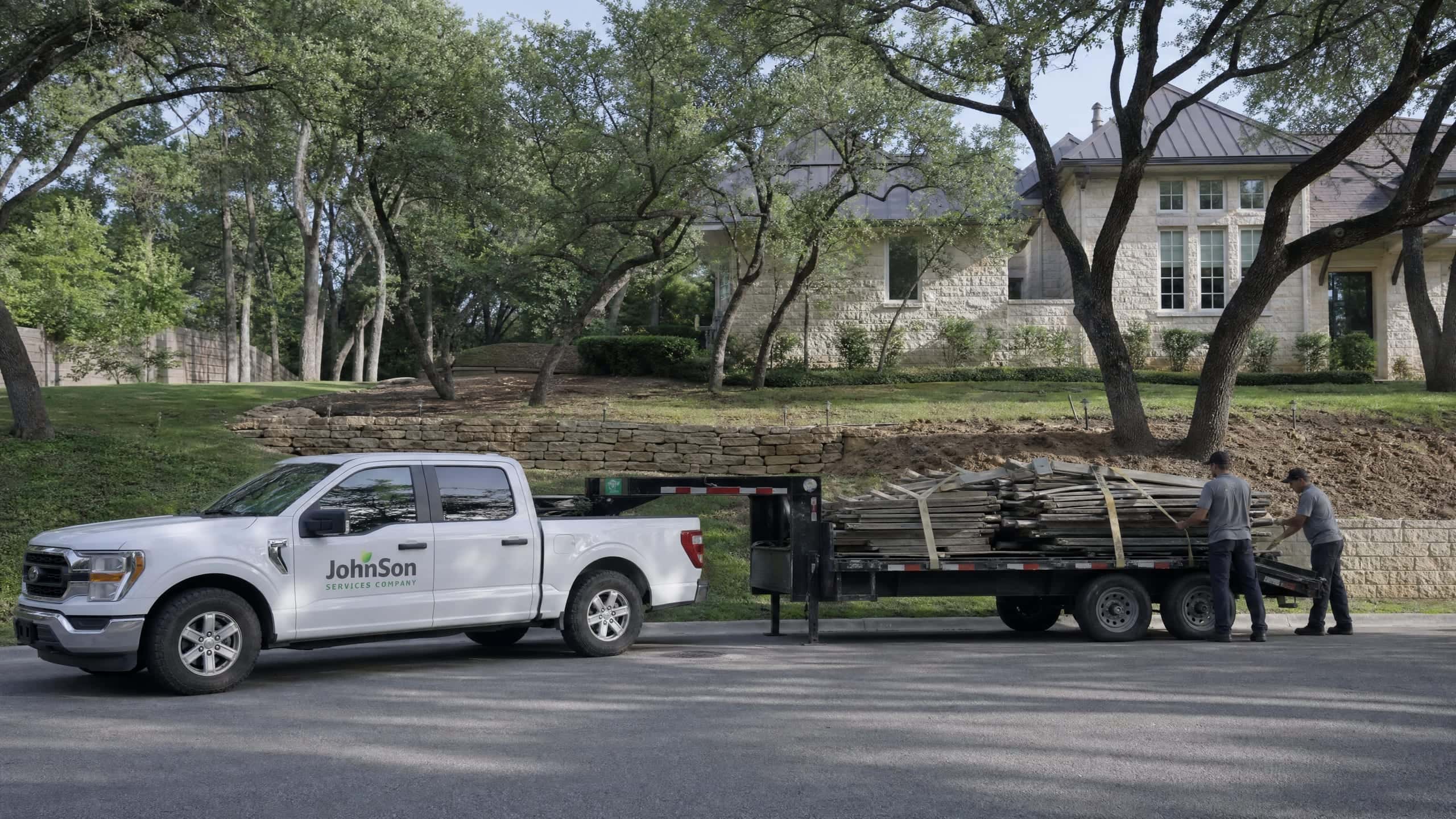
- The removal. The old fence has to come down, get loaded, and leave the property. That is a truck, a dump fee, and a crew hour that a new-build install never pays for.
Full replacement on an established home is the job we do most, more than 20,000 projects last year across four Texas metros. It is harder than a builder lot, and that is exactly why it rewards a company that measures first.
Your Old Fence Failed Early, and Texas Weather Usually Explains It
Wood rot in Texas is driven by climate, and the risk is not the same across the state. USDA Forest Products Laboratory decay-hazard values put Houston at 77.2, deep inside the high-risk band that starts at 65, while Dallas sits at 44.3 in the moderate band (USDA Forest Products Laboratory, 2009). A fence that lasted a neighbor 15 years in North Texas can fail in eight on the Gulf Coast with the same spec.
| Metro | Decay hazard index (USDA FPL, 2009) | What that band means for wood |
|---|---|---|
| Houston | 77.2 | High risk; the wettest, hardest band on wood in Texas |
| Austin | 55.2 | Moderate risk; spec still decides service life |
| San Antonio | 52.2 | Moderate risk; drier than the coast, harder than Dallas |
| Dallas-Fort Worth | 44.3 | Moderate risk; wind and clay movement matter more than rot |
InterNACHI’s life-expectancy chart puts a typical wood fence at about 20 years. If yours went down in seven, the climate did not change. The spec was wrong for it, and the second fence is where you fix that.
Learn These Four Words Before You Read a Replacement Bid
Most replacement bids differ on four terms, and a homeowner who knows them can compare two quotes in about a minute. These are the words that decide whether the second fence outlives the first.
| Term | What it means on a bid | Why it matters on a replacement |
|---|---|---|
| Ground contact (UC4A) | A preservative retention rated for buried wood | The American Wood Protection Association puts fence posts in this class; posts fail at the dirt line first |
| Picket grade (#1, #2, #3) | The quality tier of the wood picket | A bid that says only “cedar” has not told you what you are buying |
| Embedment | How deep the post sits in concrete | Wind and clay both pull on posts; depth is what resists them |
| Haul-off | Removal and disposal of the old fence | If it is not written down, assume the old fence is your problem |
Ground contact is the one to watch. Correctly treated pine posts are specified for decades of buried service under AWPA Standard U1, and an untreated or under-treated post in Gulf Coast soil is the shortest path to doing this again.
A Replacement Estimate Should Name Five Things in Writing
Get the estimate in writing and read it for scope before you read the price. The Federal Trade Commission tells homeowners to require written estimates that list the work, the materials, the completion date, and the price (Federal Trade Commission, 2024). On a replacement, that list has five specific lines.
| The line | What it should say | What a missing line costs you |
|---|---|---|
| Measured footage | Linear feet taken on site, with gates counted | A quote guessed from a map gets revised after demolition |
| Picket grade | The material and the grade number | A lower grade delivered as a higher one |
| Post spec | Post material and how deep it sets in concrete | Leaning posts by the second windy season |
| Removal and haul-off | Who tears out and disposes of the old fence | A dump run and a pile in your driveway |
| Start date | The demolition day and the finish window | An open backyard while you wait on a crew |
We quote from footage measured on site, and we name the picket grade on the page. Both of those exist to prevent the argument that otherwise happens on day two.
Verify Four Things Before Anyone Puts a Shovel in Your Yard
Scope on the page is half the job. The other half is the compliance work that happens between the signature and demolition day, and it is the part a homeowner can check in an afternoon.
| The check | Who does it | What you should have in hand |
|---|---|---|
| Texas811 locate request | The contractor doing the digging | The ticket number, requested at least two business days before excavation |
| General liability insurance | The contractor’s insurance agent | A certificate of insurance emailed by the agent, not a photocopy from the truck |
| City permit | The contractor or you, agreed in writing | Confirmation your height and materials are exempt, or the pulled permit |
| HOA approval | The homeowner, almost always | The written approval letter, dated before the tear-out |
Texas811 is a phone call, not a formality. Texas law requires notice to the state one-call system before excavation, and the crew that digs is the party that makes the request. Ask your contractor to say on the estimate that it files the locate ticket. Then know the limit of it: 811 marks public utilities up to the meter. Your sprinkler lines, landscape lighting, invisible dog fence, and the gas run to a pool heater are private, unmarked, and inches from the old fence line. That is why the estimate needs a separate line naming who locates irrigation and who pays if a line is cut.
Insurance means a certificate, sent by the agent. Ask for a certificate of insurance showing general liability with current effective and expiration dates, and ask separately whether the company carries workers’ compensation, because Texas does not require private employers to carry it. A company that cannot get its agent to email a certificate the same day is telling you something.
HOA approval sits on top of the city rule, not inside it. Most ordinary residential fences need no city permit, and homeowners read that as clearance to build. Your deed restrictions are a separate authority, and they can dictate height, picket direction, stain color, and whether a rot board is visible from the street. Get the approval letter before demolition day, not while your yard is open.
Then compare three itemized proposals line by line, not three bottom-line numbers. Lay the bids side by side on the five lines above: measured footage, picket grade, post spec, haul-off, start date. A quote that is several hundred dollars lower is usually smaller, not cheaper, and the difference surfaces as a change order.
On post spec, make every bidder state its framing in writing rather than accepting a category. Our replacements are built on pressure-treated pine framing with the posts set in concrete, cedar pickets specified by grade (#1, #2, or #3, named on the estimate), and a treated ground board at grade so the pickets never touch soil. Some Texas builders quote galvanized steel posts instead, which is a legitimate answer. What is not a legitimate answer is a bid that says “posts” with no material, no treatment rating, and no embedment depth.
Who Hauls Off the Old Fence, and On What Day?
Demolition day is where an under-crewed contractor’s schedule breaks. The old fence comes down in hours, and from that moment the yard is open, the dog is inside, and every delay is yours. The average U.S. specialty trade contractor employs fewer than ten people across roughly 599,000 establishments (Bureau of Labor Statistics, 2025), which means most fence companies are running one crew and no backup.
Ask two plain questions. Who tears the old fence out, and does that crew stay through the rebuild? A company that subcontracts demolition to a separate outfit has added a handoff on the one day you cannot afford one.
Crew Depth Decides Whether the Promised Date Holds
Crew count is the most useful number a fence company can give you, and almost none of them publish it. We run over 100 crews, with 25 to 30 in Houston and 5 to 15 in every other market, so a crew missing a day never stops a job. Depth is local. What matters is how many crews work the metro you are actually buying in.
That depth is what lets us start work within about 4 days of an accepted quote, and finish most residential jobs the day they start. A one-truck contractor can build a beautiful fence. What it cannot do is absorb a sick day, a rained-out morning, or a second job running long.