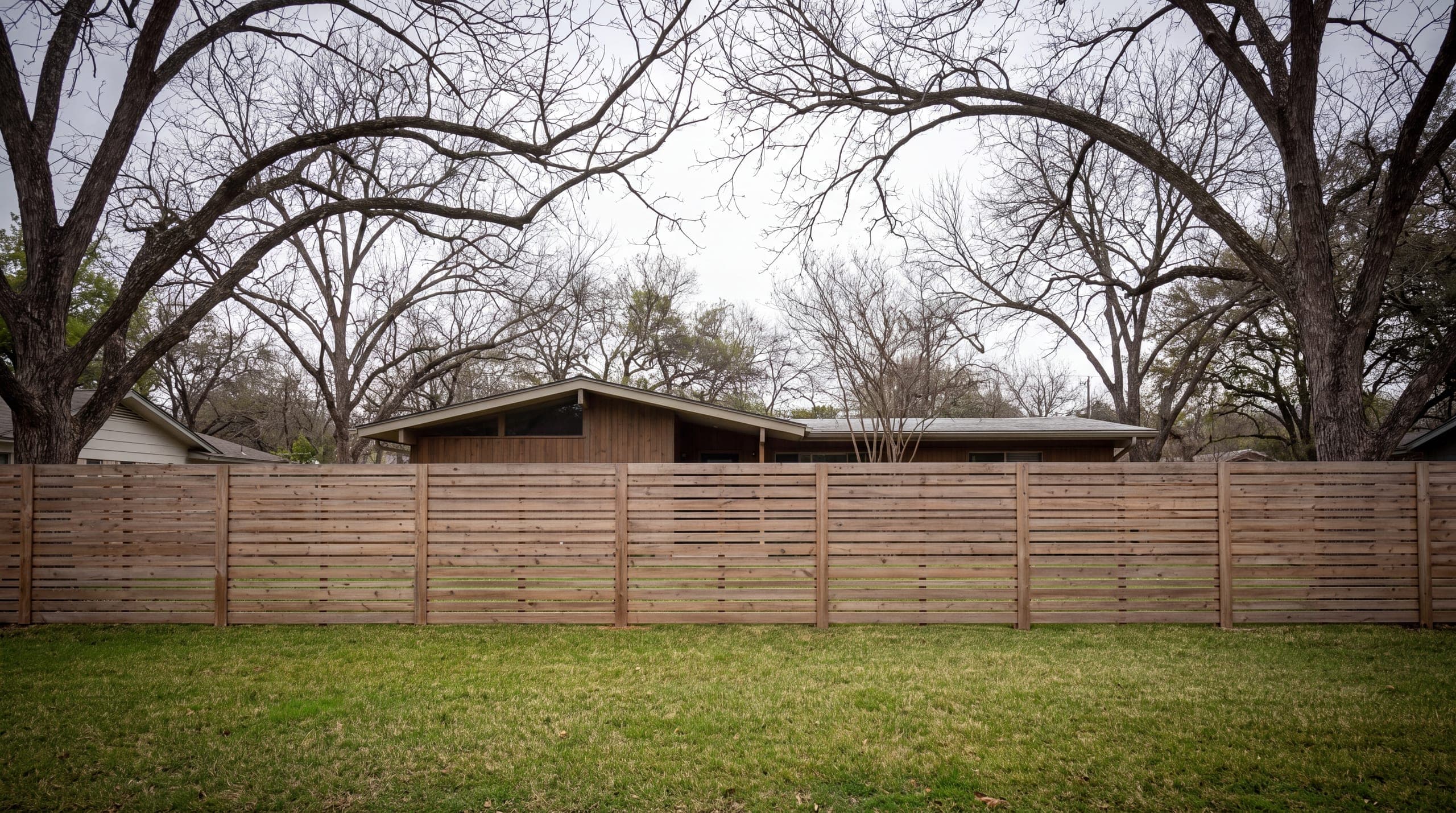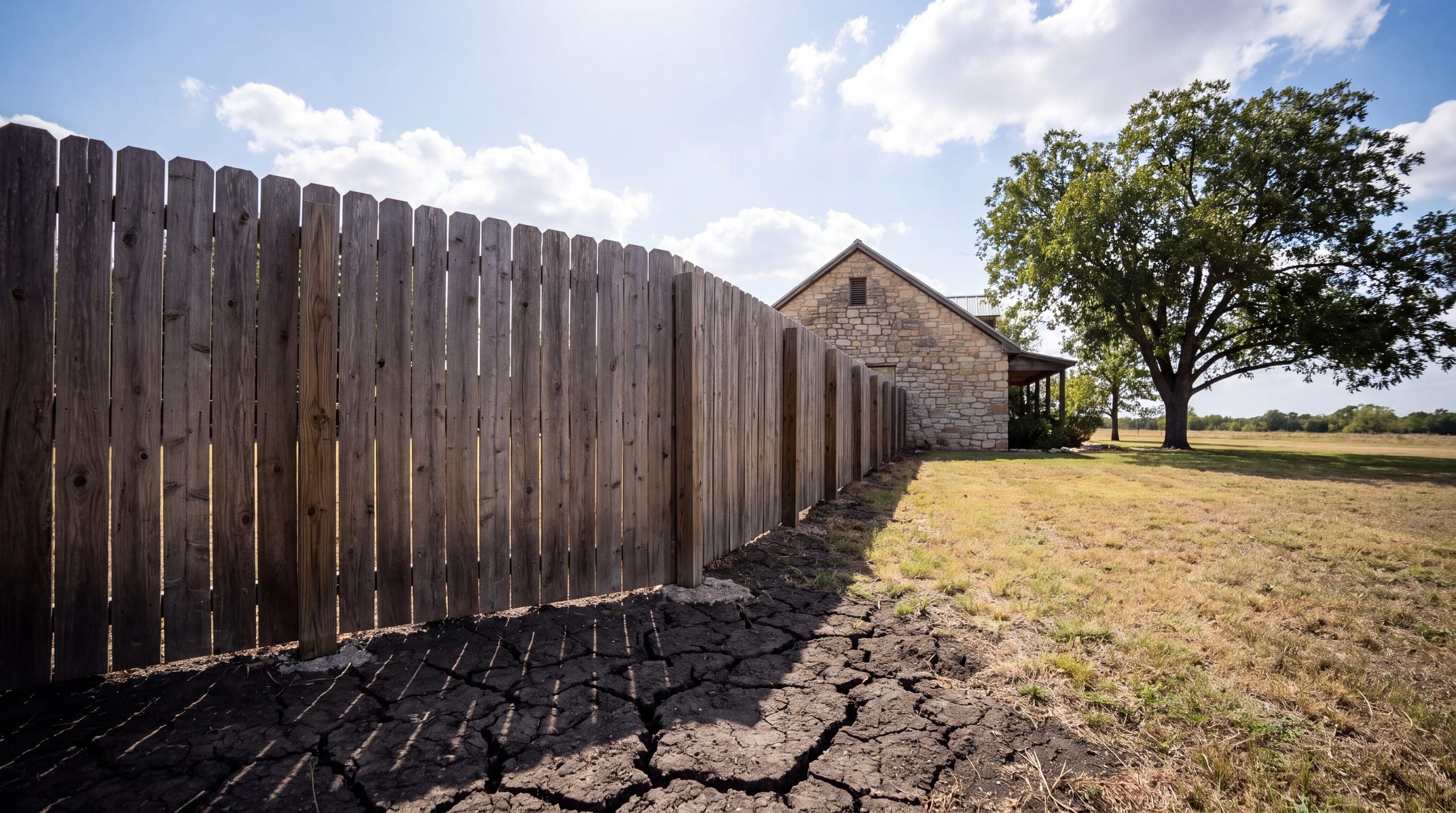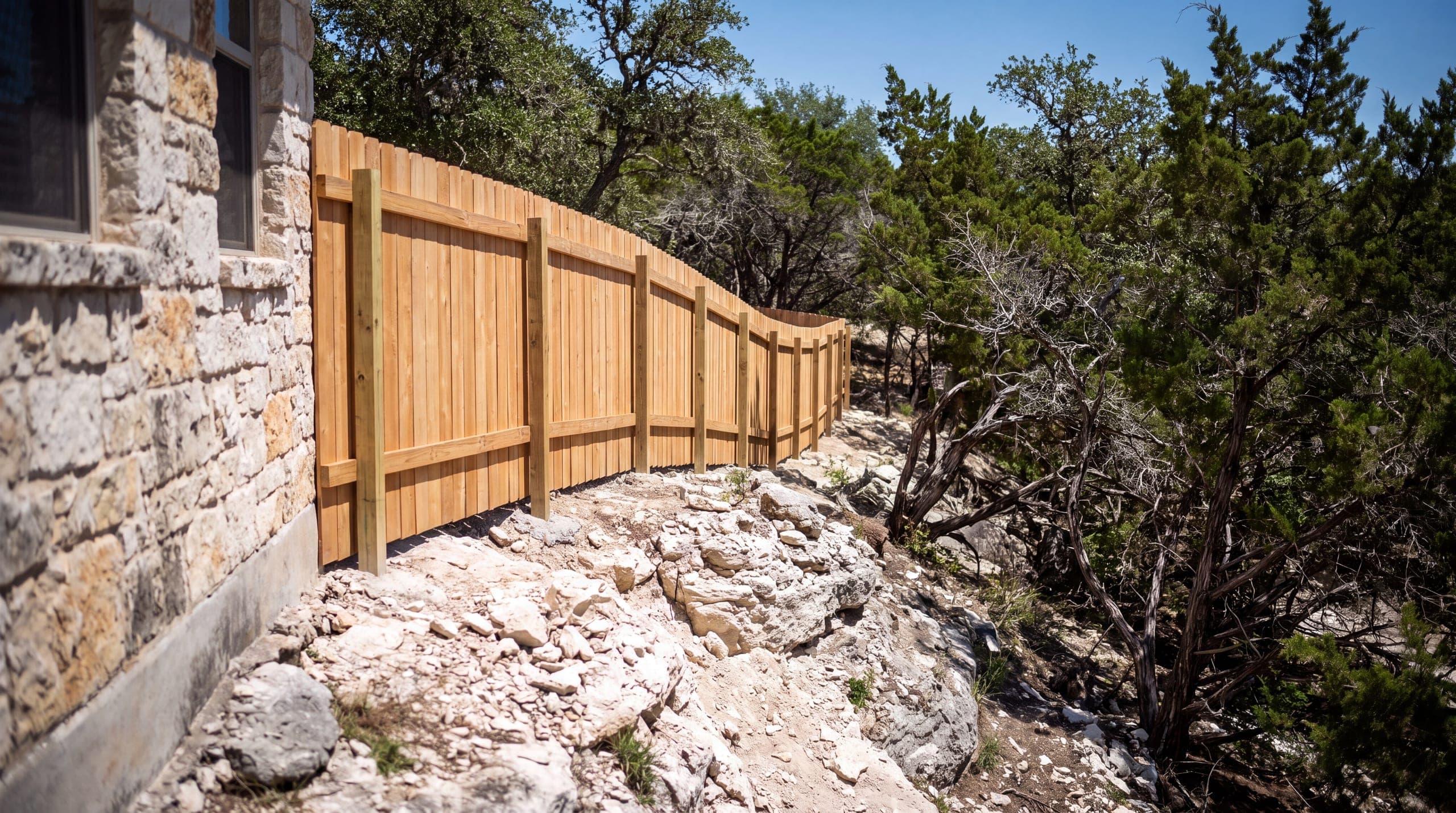

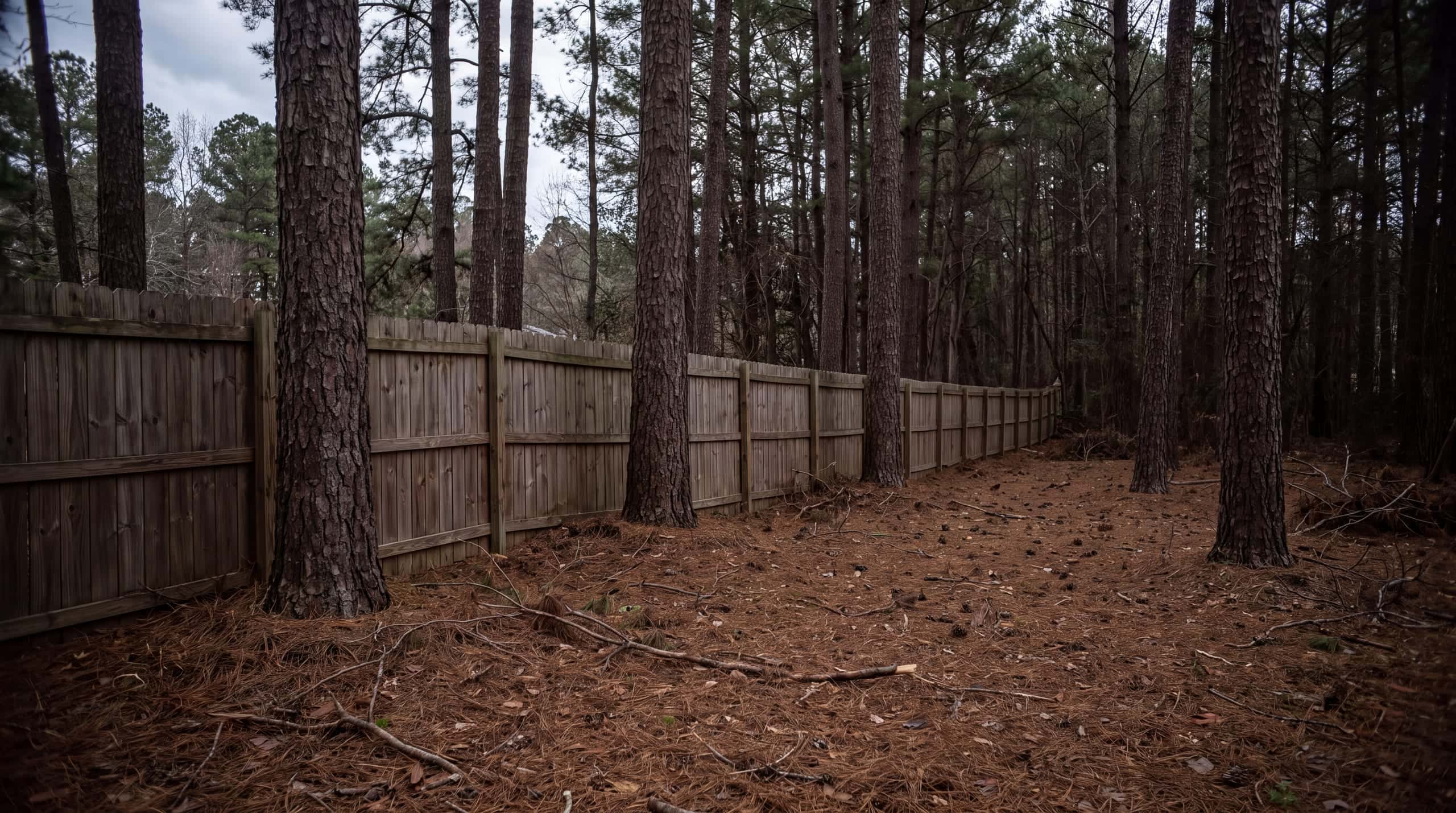
The best fence company for a wooded Kingwood lot is the one that specifies the fence for the trees before it quotes the footage: cedar heartwood pickets, posts treated for ground contact and set deep enough for wet clay and wind, and a crew that can work around roots. Johnson Fence works Kingwood from its Houston North office in Tomball, rated 4.9 stars across 69 Google reviews (October 2026), with 25 to 30 crews in the Houston market.
Kingwood is 14,000 acres of tree cover, and the trees are why fences here fail on a different schedule than fences ten miles west. A shaded fence line stays damp after every rain, and damp is the one condition that decides how long wood lasts.
Why Do Fences Fail Faster on Wooded Kingwood Lots?
Because shade keeps the wood wet, and Kingwood already sits in the country’s highest decay band. The Forest Products Laboratory scores Houston at 77.2 on the wood decay hazard index, where anything above 65 is the high-risk band (Carll, 2009). Kingwood sits inside that metro reading, in the wettest, most shaded corner of it. Dallas scores 44.3 on the same scale, which is why a fence specification that works up there is a different fence down here.
The mechanism is simple enough to check yourself. Serious decay only starts once wood moisture climbs above the fiber saturation point, an average of 30%, and air-dried wood usually sits at 20% or below, which the Forest Products Laboratory calls a reasonable margin of safety against fungal damage (Forest Products Laboratory, 2021). Wood that dries out between rains is fine. Wood that never gets the sun to dry it is not.
A Kingwood back fence under mature pines and hardwoods is the second case, and no amount of craftsmanship fixes a board that stays wet.
Is Cedar the Best Fence Wood for a Shaded Kingwood Lot?
Yes, cedar is the right answer here, and the grade matters more than the word. Fence companies selling into Kingwood advertise that cedar naturally protects a fence against bugs and decay. That is true of the heartwood and it is not true of the whole board.
Decay resistance lives in heartwood, and the sapwood of the very same tree fails years sooner. A Forest Products Laboratory study that exposed nineteen species on a test fence for up to 22 years rated western redcedar, redwood, and Douglas-fir heartwood among the most decay-resistant woods above ground, and found the sapwood of those same species failed markedly earlier (Highley, 1995). A separate durability synthesis rates western redcedar as resistant and loblolly pine, the standard Texas builder picket, as only moderately resistant to nonresistant (Scheffer and Morrell, 1998).
So “cedar” on an estimate tells you almost nothing. “Western red cedar heartwood” tells you what you are buying.
| Material | How long it holds up | Source |
|---|---|---|
| Cedar | About 20 years | InterNACHI |
| Pressure-treated pine posts | Decades in the ground when treated right | AWPA Standard U1 |
| Vinyl (PVC) | Over 100 years | InterNACHI |
| Composite | 25 years under the residential warranty | ASTM D7032 and Trex |
| Ornamental steel | Lifetime under the residential warranty | Ameristar Montage |
What Does Tree Cover Do to a Fence Line?
It keeps the boards wet, puts roots where the post holes go, and pools runoff at the low corner, and an estimate that names none of them was written from a satellite photo.
- Shade keeps the boards wet. A fence line that gets no direct sun holds moisture between rains, which is the exact condition the decay index measures. It is the single biggest reason two identical fences in the same subdivision age differently.
- Roots move the posts. Mature pines and oaks put structural roots exactly where post holes want to go. A crew that hits one and shifts the hole eighteen inches without telling you has changed your fence line and your gate swing.
- Runoff pools at the low corner. Kingwood lots drain toward greenbelts and gullies, and the bottom of that run is where posts sit in standing water after a storm. That corner needs a different post spec than the rest of the fence.
None of that shows up on a price per foot. All of it shows up in year seven.
Why Do Fence Posts Fail First in Kingwood?
Wet clay and wind work on the posts before the boards show anything. The boards get the attention and the posts do the work. A solid privacy fence catches almost the full wind, and the Houston metro is mapped at design wind speeds of 130 to 140 mph for ordinary structures (ASCE 7-22, 2022). That load travels down the pickets, into the post, and out through whatever is holding the post in the ground.
The code turns that into a number. How deep a post has to sit grows with the wind load and the height of the fence, and shrinks with stronger soil, and the code lets the soil push back over only one third of the buried depth (International Building Code, 2021). Wet, shifting ground means a deeper hole and more concrete. There is no way to price around that and still have the fence stand through a Gulf Coast storm.
This is why two estimates for a 6-foot cedar privacy fence can differ by hundreds of dollars and describe two different fences. One of them specified the post depth.
What Should a Kingwood Fence Estimate Include?
You do not need to become a fence expert to tell a specified estimate from a thin one. You need four answers in writing.
| Your situation | Ask for this in writing | Why it decides the job |
|---|---|---|
| Fence line under heavy tree cover | The wood species and its grade, in writing | Heartwood resists decay and sapwood does not |
| Posts going in near mature trees | What happens when a crew hits a structural root | An unrecorded shift moves your fence line and gate swing |
| The low corner where water pools | Post depth and footing size for that run | Code sets embedment from wind load and soil strength |
| A fence replacing one that failed early | Whether old fence removal and haul-off is included | Removal is priced apart from the per-foot number |
Get those alongside the work, the materials, the completion date, and the price, and never pay the full amount up front.