
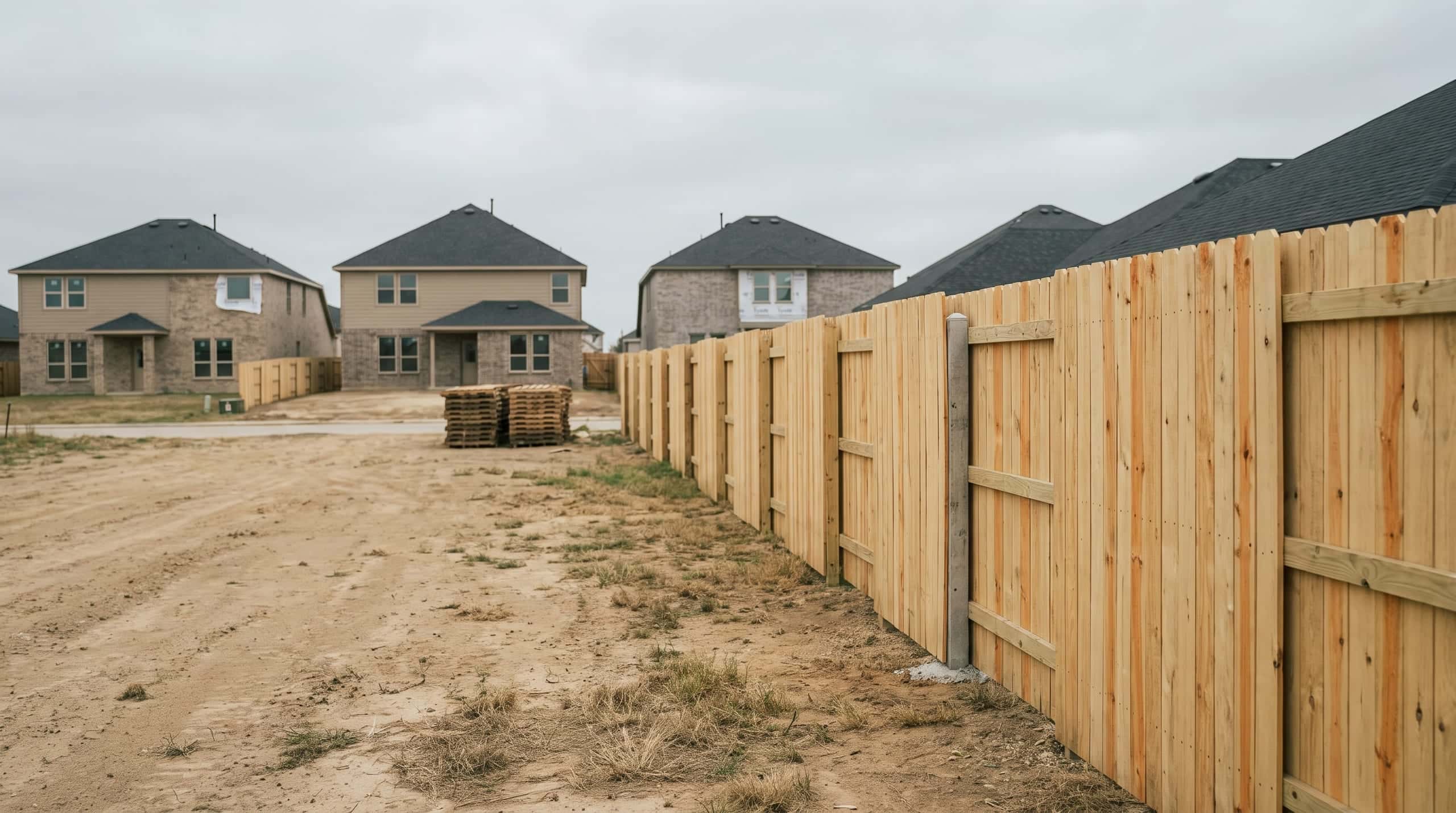
A builder does not lose money on a fence in the bid. It loses money in the weeks after, when the crew does not show, the picket grade turns out thinner than the quote implied, and a finished house waits on 180 feet of privacy fence before the final walkthrough. Here is the checklist a purchasing or construction VP should run before awarding fence work, built around the date you are actually buying.
The Fence Is the Last Trade Standing Between You and a Closing
Fencing lands at the end of the build, after every trade that can be worked around has already cleared out. Single-family homes built for sale averaged 7.6 months from permit to completion in 2024, and 9.1 months from authorization (U.S. Census Bureau, 2025). Every one of those months is financed. The backyard fence sits between a finished house and a released check.
That position is what makes the fence sub different from a trade in the middle of the schedule. A framer running two days late gets absorbed. A fence crew running two days late moves the walkthrough, the certificate of occupancy, and the closing date you already gave a buyer.
We learned this from the inside. From 2002 to 2019 we did one thing: backyard privacy fencing for regional and national homebuilders in Houston, including D.R. Horton, LGI, Lennar, and Pulte. We ran the company more like a logistics operation than a fence contractor, because being last on site leaves no room to catch up.
A Low Bid Moves Cost Out of the Contract and Into Your Carry
The cheapest fence bid does not delete cost. It relocates it to the line item you cannot invoice. The skilled-labor shortage cost single-family builders $2.663 billion in higher carrying costs in one year, on top of $8.143 billion in lost production, about 19,000 homes not built (Home Builders Institute and NAHB, 2025). Carrying cost accrues daily, quietly, and against your margin.
There is less room to absorb it than there used to be. Construction costs hit 64.4% of the average new-home sales price, a record high in a series going back to 1998 (NAHB, 2025). Homebuilding is a subcontracting business, so that number is decided almost entirely by which subs you trust.
So the real question in a fence bid is not the per-foot price. It is what the sub does on the Tuesday a crew calls in short.
Crew Depth Is the Number That Predicts a Kept Date
Ask how many crews the sub runs, then ask how many of those crews work the metro your lots are in. Most fence contractors run one to three. We run over 100 across Texas, with 25 to 30 in Houston and 5 to 15 in each other market. A one-crew shop with a sick foreman has no second option, and the thing that moves is your date.
Crew depth is local, which is why the second question matters more than the first. A statewide crew count means nothing if all of it sits four hours from your phase.
| Scope you are awarding | Where the schedule usually breaks | What to require from the sub |
|---|---|---|
| Single spec home | One crew booked on a bigger job the same week | Named install date plus a backup crew in that metro |
| 40-lot phase release | Fences trickling in behind closings already scheduled | Crews assigned per week, with weekly footage committed in writing |
| Subdivision perimeter, monument, dog park | Multiple scopes handed to multiple specialty subs | One accountable contractor carrying all of it |
| Storm rework across a standing community | Every fence sub in the metro booked at once | Crew count in that metro, stated as a number you can check |
But Crews Mean Nothing Without Materials Already Measured
Crews without material on the truck are just people standing in a yard. Ask the sub when the job gets measured, when the material gets ordered, and where it sits between those two events. A sub who orders after the award is telling you the install date depends on a supplier they have not called yet.
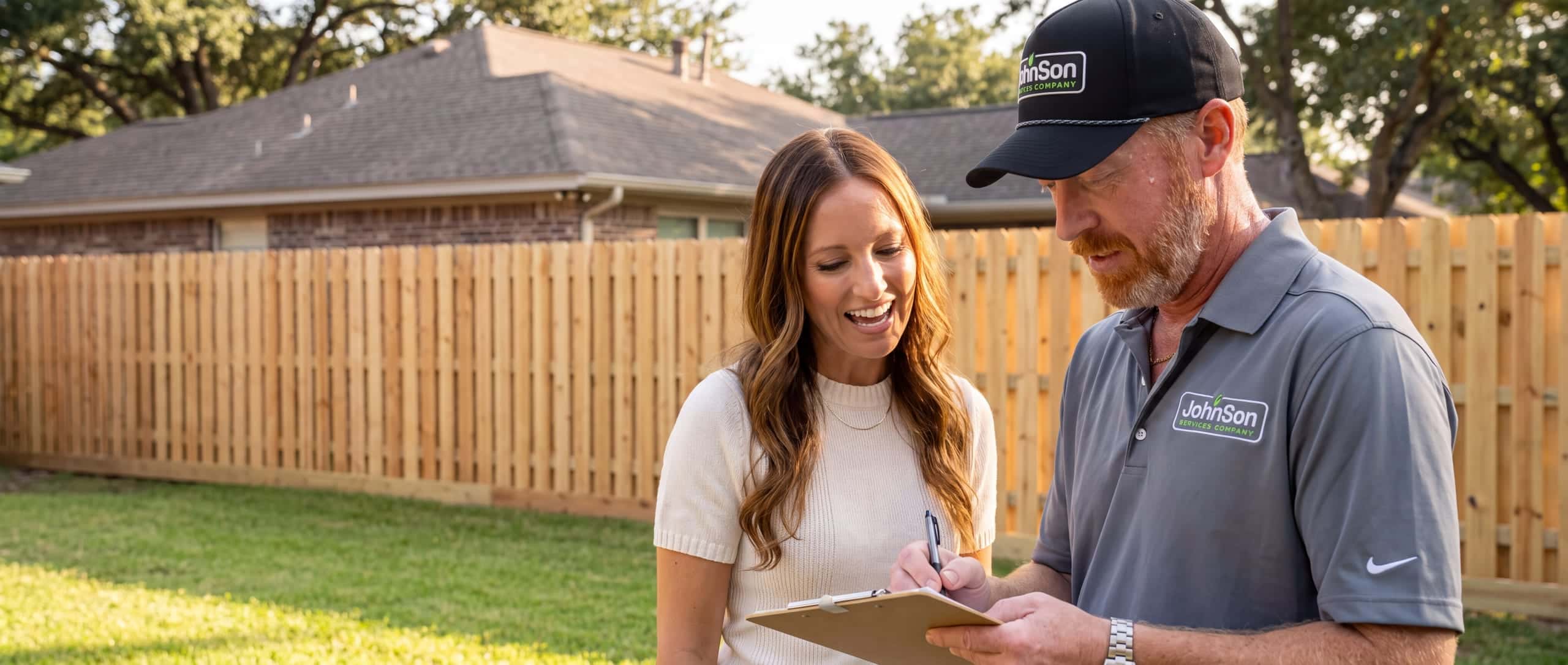
Our sequence is deliberate and it is expensive. A salesperson meets the customer on site, measures the linear footage, and confirms the fence type and picket grade before the quote goes out. A quote goes out the same day on 95% of real leads, work starts within about 4 days, and most jobs finish the day they start. We measure every job and load materials and crews before anyone leaves the yard.
There is one more reason to ask about material. We are Master Halco’s largest-volume customer, holding the 2026 Largest Volume Customer awards for the Southwest Region and the World, and a top customer of Solid Wood. That buying power sets our picket cost, and we pass it through, so a builder gets the same fence for less because we buy the wood for less.
Put the Picket Grade in Writing Before Anyone Quotes It
Two bids for the same fence can differ by hundreds because one of them quietly downgraded the pickets. Grade is where a low fence bid usually hides, since a bid that says only “cedar” or “pine” has named no grade at all. We quote the picket grade by number, #1 to #3, so the comparison you run is a real one.
Below are the terms that belong on a builder’s fence spec in writing.
| Term | What it means on a spec | Why it changes the job |
|---|---|---|
| Picket grade #1 to #3 | The stated grade of the picket, written as a number | A bid naming only the species can be filled with a lower grade |
| Ground contact, UC4A | The AWPA use category for in-ground posts, with a minimum preservative retention | Posts specified for UC4A are engineered for decades of ground contact (AWPA Standard U1) |
| Heartwood vs sapwood | Which part of the log the boards were cut from | Western redcedar heartwood tested over 20 years above ground, while sapwood of the same species failed markedly sooner (USDA Forest Products Laboratory, 1995) |
| Post spacing and embedment | Center-to-center spacing and how deep posts are set in concrete | Wind loads a solid fence over its whole face, and the end and gate posts fail first |
Write these into the scope before the bids come in. Then every number you compare is describing the same fence.
Texas Never Licensed Your Fence Sub, So Verify It Yourself
Texas has no statewide general-contractor, home-improvement, or fence-contractor license, and the state’s licensing authority regulates only specific trades such as electricians and HVAC contractors (Texas Department of Licensing and Regulation, 2026). Anyone with a truck can bid your phase. That puts the whole burden of verification on your purchasing desk.
Fence Contractor USA sets a general liability floor of $1,000,000 per occurrence and $2,000,000 aggregate for fence work, and notes that workers’ compensation runs 8% to 15% of payroll, which is why an uninsured sub can underbid an insured one and still eat.
| Document | How to verify it | What a refusal tells you |
|---|---|---|
| Certificate of insurance | Request it direct from the carrier or agent, with your entity named | The policy has lapsed or never covered the crew size |
| Workers’ compensation | Confirm coverage extends to subcontracted crews, not office staff only | An injury on your lot becomes your exposure |
| Bonding | Ask for the bond and the surety’s name | The sub cannot qualify for one |
| Complaint record | Check the BBB directory and the file behind the rating | The rating is newer than the company |
We are licensed, bonded, and insured, have held an A+ BBB rating with accreditation since March 2003, train crews to OSHA standards, and install gate operators to UL325.